
Build vs. Buy: What It Actually Costs to Roll Your Own AI Security Engineer

TL;DR
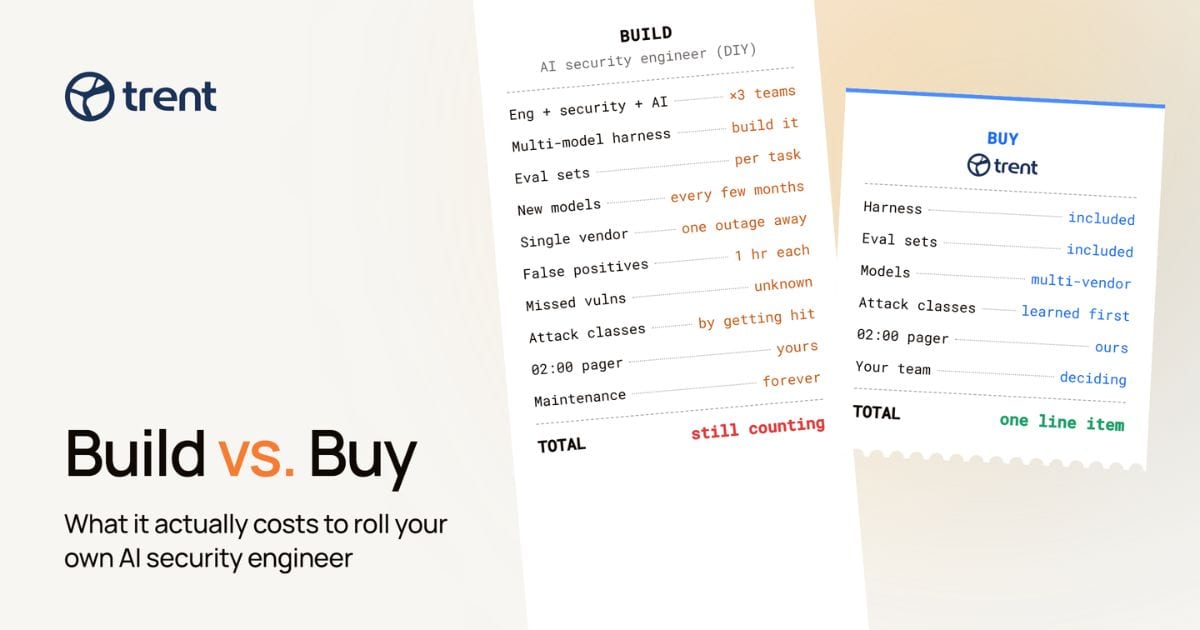
Build if…
- your security knowledge is truly unique to your company
- you can keep engineering, security, and AI experts committed long after the demo
- you can afford owning it forever, 2:00 a.m. pager included
Buy if…
- you’d rather not learn about new attack classes by getting hit
- you want your best people making decisions, not maintaining tools
- you can’t afford your security program depending on a single model provider
So, should you really build it yourself?
Let’s face it, I am biased. I am building a security company called Trent AI. But I feel like there are still some good learnings worth sharing. When I talk with customers about Trent, we rarely spend much time comparing our AI Security Engineer to the old static tools. That debate settles itself pretty fast. But, the question I get instead sounds like this:
“Could we just use a frontier model and build this security tool ourselves in a few weeks?”
It’s a fair question, and it takes me back to my AWS days building storage and data analytics products. In the early cloud years, build vs. buy was a constant question of every enterprise deal I did. And I have to admit, I did a few of them. Many technical teams thought hard about keeping their own data centers and building their own storage and data platforms. A few years later, the question quietly went away. The market matured and the answer got obvious, mainly because of specialization, opportunity cost, and market dynamics.
AI reopened the question, especially in the Security space, because it collapsed the cost of building, gave you the feeling specialization is worthless, and markets are so quickly evolving. And it’s pretty intriguing to just point a frontier model at a repo, and you’ve got a working security scanner in a few days, sometimes hours. So the question is legitimate: can we just build this ourselves now?
If, you decide to self-build
You own the misses and the noise
Point a frontier model at a repo. Run it once, you get a handful of real findings, oftentimes genuinely good ones. Run it again, different findings. Also valuable. But neither run tells you what it missed.
For a lot of engineering work, that’s fine. Ask an agent to write tests, it gives you twenty solid ones, misses a few edge cases, and you’re still ahead.
Security doesn’t work that way. The one vulnerability it misses is the one in the next incident report. And every finding that isn’t real, costs an engineer an hour to close. Security teams know both failure modes well: the miss you never see, and the noise that buries the ones you should. Any tool you build has to be measured on both.
At Trent AI, we measured the misses on CWE-Bench: 28 production CVEs across 22 real repos, scored on whether a tool points at the file that was actually fixed. Raw Claude Code found 8.7%. Static analyzers under 4%. Trent’s AI Security Engineer 25%, roughly 3x the best alternative.
The noise is harder to measure honestly, because real repos contain real bugs beyond the labeled ones, so we didn’t publish a false-positive rate. But one number tells the story, Claude Code named the right vulnerability class somewhere in the repo 65% of the time, but landed on the fixed file 8.7% of the time. That gap is a queue of plausible-looking findings in the wrong place, each one needing someone to open it, chase it, and close it.
False positives cost more than time
Every false alarm teaches developers to ignore the next one. Trent checks each finding against how your application actually works before it reaches them.
So what does that all mean. Fixing both takes more than a better prompt. It takes some deliberate thinking what model, from what vendor, to access when, and how. Let’s call it a harness: multiple models and providers, a judgment layer that improves over time, and grounding in your own architecture.
As Julien Brouchier, Trent’s Security Lead, puts it: “Finding issues has never been the problem in the companies I worked for. Knowing what we missed, and which ones actually mattered, that was a whole other game.”
So, I guess the next obvious conclusion is, let’s build a harness across multiple vendors and models, and get this going! Right?
You’re taking on three problems, not one
A harness sounds like one thing to build. But in reality it’s three, and each one is harder than the last in my experience, so let me explain.
- The first issue many companies run into is organizational. A harness isn’t one team’s project. You need engineering for the pipelines, the indexing, and the data structures that let a model reason about a codebase instead of a single file. You need security to define what to look for and what a finding means in your architecture. And you need AI expertise to make the whole thing run in an agentic way. Those three groups don’t sit together in most companies, and they have to stay committed long after the first demo. That sounds easy but for most enterprises that’s already the breaking point.
- The second is technical: knowing when to use which model and which vendor vs. one model and one vendor is possible but it requires a lot of work. A large model where deep reasoning pays off, small specialized ones for well-scoped high-volume work, an open source one for your on-prem environment, and each fed the right context at the right time. Reaching many models is arguably easy via gateways but knowing which job each model can safely handle, and proving it, is a different challenge. That means eval sets, per-task benchmarks, and the judgment to know where cheap and fast is good enough, and where it isn’t. Oh, and let’s not forget all these frontier labs are innovating like crazy, so a new model is being released every few months. You are not building a prototype, but a product grade security solution where cost and performance implications are significant. And the market you got yourself in, is moving at a crazy speed.
- And then there is the third risk which is all about vendors. That one stopped being theoretical this summer when Anthropic suspended access to Fable and Mythos and everything wired directly to those models stopped working. If your whole security program rests on one provider’s model this is a single point of failure risk. At that point you don’t own a solution, you own a dependency. I don’t want to be in the room when you have to explain your board that your security program was on pause because of that.
You’re paying to learn on your own production system
Even if you have the expertise, commitment, and resources across all three teams, that only gets your security tool built. But the security and security landscape shifts every few weeks, sometimes days, and the security expertise feeding your security tool has to keep learning too.
That’s the expensive part. Looking at history here, a typical security team’s expertise has a shape: the attack classes they’ve seen up close and the incidents they’ve lived through. When a genuinely new class shows up, nobody has that shape yet, and the most expensive way to get it is to be the one who gets hit.
Agent skills are a recent example, and they barely existed a year ago. A few weeks ago we pulled metadata on all 52,652 ClawHub skills, and only about 22% came back clean. Because our eval sets forced the system to learn this attack class, it now catches 94.6% of dangerous skills, while the next best scanner catches 54.1%. A tool your team built last year catches none of them, because the market has just moved on so quickly.
Say it differently, the ongoing cost to maintain the relevance of your security tool is much higher than the usual maintenance cost for most other software. It’s ok if your internal accounting tool doesn’t follow the latest design principles. But it becomes a fundamental business problem when your internal build security tool, is out of date. That means you need to spend lots of money and resources on your security tool.
You’re spending your best people in the wrong place
Let’s be upfront about this. I believe, plenty of teams have the expertise to build their own security tools in-house. Having it and spending it there are two different decisions though, and this one is about allocation, not capability. The people who could build your harness are the same people you need for everything else, and be honest about whether security tooling is actually your moat. For most companies it isn’t, and the discipline is keeping your team’s focus on the work that actually makes you different.
Our CEO, Eno Thereska laid this out in Your Developers Outnumber Your Security Team 80 to 1. Your security engineers are already outnumbered, and you can’t hire the gap away. Building spends that resource twice: once to build, and then forever to own. That is oftentimes not the best way to spend your time.
Let me give you an example of a simple way to feel what “own” means: when your in-house tool breaks at two in the morning, one of your engineers is the one getting up to fix it, because because the attacker will not wait until Monday. Every hour your best security people spend operationalizing and maintaining tooling is an hour they don’t spend on the decisions only they can make. This is actually a really interesting point, and something it took me a bit to grasp. But in today’s world you can build whatever you want pretty quickly. The question is do you have conviction it’s the best choice, and are you willing to maintain it with a 24/7 SLA, given all other areas of your business you could spend time.
Justus Post, Cyber Security Leader at Arvest Bank, went through exactly this decision, and his reasoning covers most of what I’ve laid out above: “Initially we thought about building on top of a frontier model ourselves, and we had a prototype running within a few weeks. The real cost came later, and in the end we decided against it for two reasons. First, I did not want our best security people tied up maintaining an internal tool when they could be using the best tool available and owning the decisions. Second, we could not justify the dependency on a single vendor and model. We run a critical business, and a provider pulling access, which happened just recently, is not something I could explain to a regulator as the reason our security program stopped.”
If, you decide to buy
Now, let’s flip the argument. If you buy, I’d argue you’re offloading all of that, the harness, the multi-model orchestration, the eval sets, the vendor risk, the new-attack-class learning curve, and operations, to a company whose entire job is just that.
The best argument for building I’ve heard is around that the hard part of any AI system isn’t the model itself, but everything your company knows, that no vendor does. And that if you have to spend weeks teaching a vendor all of that, you might as well build it yourself. I agree with that. For most business processes, I think that’s right.
Security though is a bit different, I’d argue. The knowledge that makes a security engineer good isn’t specific to your company: how an attack class works, how an exploit chains through an agent, how a model behaves under hostile input. What is specific to you is your architecture, and a good system reads that from your code, not from onboarding calls. Build when the hard knowledge is yours. Buy when it belongs to the field.
Part of what you’re paying for is that someone already had the first encounter with a new attack class, on their own time rather than on your production system. The other part is less glamorous: operations. The real thing has to run on every commit and every pull request, which means monitoring, redundancy, incident response, and someone who owns the pager when a model provider degrades overnight. Some companies treat operational posture as a discipline and they’ll tell you it’s one of the main reasons they buy anything critical. That level of operational maturity is expensive and only pays for itself at scale. A vendor spreads the cost across every customer. An internal tool carries it alone.
The fear I hear most is losing control: someone else’s system deciding what counts as a risk in your environment. But there are two jobs here, producing findings and deciding what matters, and only the first belongs to the system. As our Co-Founder and Chief Scientist, Neil Lawrence puts it in The Judgment Layer: “Accounting is the numbers. Accountability is the human authority and the judgment.”
A severity score can’t tell you that a medium-rated bug in a multi-tenant API matters more tonight than a critical one behind your admin wall, but the engineer who knows your architecture can. A good system hands them that call with the evidence and reasoning, free to overrule. A wrapper hands you a verdict without either. Buying well gives your engineers more of the decisions that matter, not fewer.
If you defer, it’s a decision too
And finally, just make a decision. “Run a coding agent for now, revisit next year”; sounds like the cautious choice, but it really rarely is. So let me end where I started. Great teams can build security solutions themselves, no question. For most teams though, I’d argue building your own security tooling still isn’t the right call. Not because you can’t do it, but because you have better options.
Which of these findings are actually real?
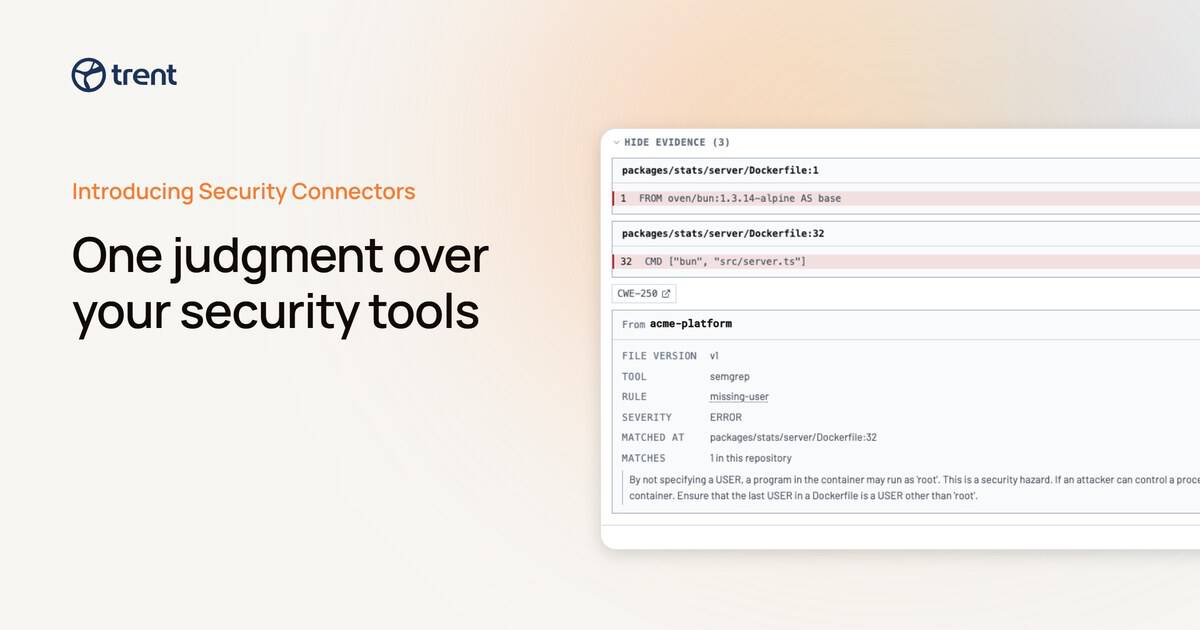
Bring in the results from your security tools. Trent checks each one against how your application really works.
From your security tools
SQL injection in test fixtureNoise
Token passed to agent stepHigh
Same issue, second toolDuplicate
Unused dependency alertUnreachable
→
After Trent
Token passed to agent stepHigh
Grounded in release.yml : 42
Fix prompt readyNext step
Request access
Works with any security tool that exports SARIF.