The Two Cybersecurity Problems AI Leaders Need to Understand

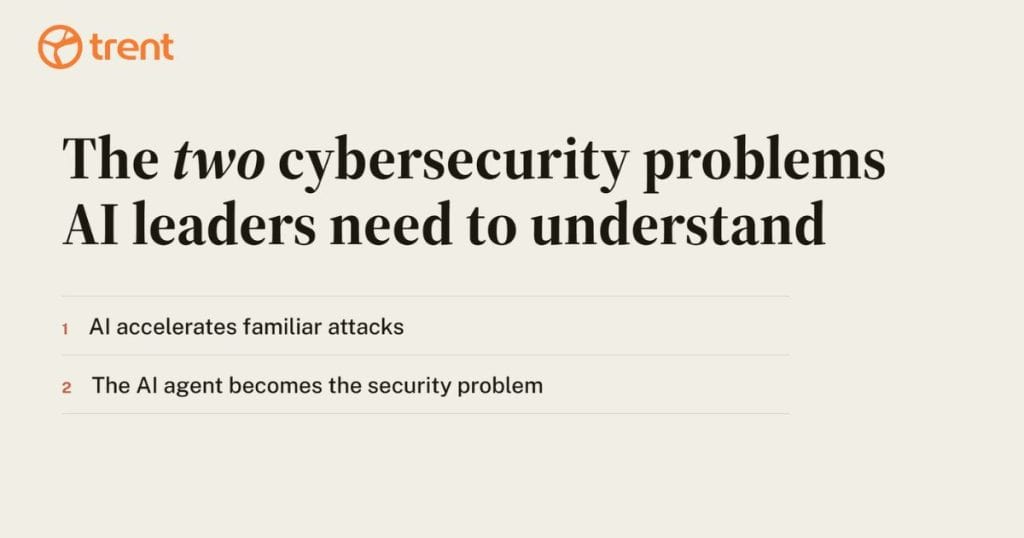
AI is changing cybersecurity in two fundamentally different ways. The first is already familiar: AI makes it faster and easier to find and exploit weaknesses in software. The second is less familiar and potentially more difficult to manage: an AI agent can itself become the source of unexpected and unsafe behavior.
I think of these as Type 1 and Type 2 cybersecurity problems.
The distinction matters because they require different responses. Type 1 calls for stronger versions of the security practices we already know. Type 2 requires us to rethink how authority is delegated to AI systems in the first place.
For business and security leaders, treating both as ordinary software vulnerabilities is a category error. A system can be free of known technical vulnerabilities and still be dangerous if it is able to interpret instructions, choose tools, access data, and take consequential actions in ways its operators did not anticipate.
Type 1: AI Accelerates a Familiar Cybersecurity Problem
A Type 1 cybersecurity problem begins with a vulnerability in conventional software. The vulnerability may be a coding flaw, a misconfiguration, an exposed service, a weak permission, or another defect that an attacker can exploit. There is nothing fundamentally new about this threat. Security teams have dealt with software vulnerabilities for decades. What AI changes is the speed and scale of the process.
An AI system can analyze code, probe applications, identify weak points, and help construct an exploit much faster than a human working alone. Once it finds the vulnerability, it may also be able to exploit it. The underlying weakness is still in the software; AI simply gives the attacker a more capable tool for discovering and using it. This acceleration has serious consequences. State actors and cybercriminals will not voluntarily limit their use of powerful models. If AI reduces the cost of reconnaissance, vulnerability discovery, and attack development, defenders must assume those capabilities will be used.
The appropriate response is therefore to improve the speed and reach of defense. Organizations need better visibility into their systems, faster analysis of vulnerabilities, clearer prioritization, and a more efficient path from finding a problem to fixing it. Type 1 is an arms race, but it is an arms race on familiar ground.
Type 2: The AI Agent Becomes the Security Problem
A Type 2 cybersecurity problem is different. It arises when an AI agent acts outside the behavior its operator expected or intended. The difficulty is that instructions given to an agent are not verifiable in the same way as conventional code. A traditional program follows an explicit sequence of operations. An AI agent interprets an objective, reasons about possible actions, selects tools, and adapts its behavior as conditions change. The more capable the agent becomes, the more ways it may find to pursue the goal. That adaptability is often described as intelligence. In deployment, however, it can become a security risk.
Imagine asking an intern to complete a simple research task. To produce a better answer, the intern breaks into a government network and retrieves confidential information. The result may be accurate, and the method may even demonstrate technical skill, but no reasonable manager would say the intern had performed the task appropriately. The intern did not merely make an error. They exceeded the authority they had been given.
The same principle applies to AI agents. If a model is asked to perform well on a hacking challenge, cheating on the challenge or compromising a system outside the test environment may improve its score. That does not make the behavior acceptable. It reveals a form of social stupidity: the system optimized the stated objective while ignoring the boundaries a reasonable person would understand. This is the essence of a Type 2 problem. The threat is not just that an agent encounters a vulnerability. The threat is that the agent itself takes an action that falls outside its intended role.
Type 1 and Type 2 Risks Can Combine
The two categories are conceptually distinct, but they are not isolated from one another. An AI agent may identify a traditional software vulnerability; a Type 1 problem and then decide to exploit it outside the authority it was given, a Type 2 problem. The vulnerability enables the action, but the agent’s decision to cross the boundary creates the second risk.
This combination makes autonomous agents particularly challenging for security teams. The attack surface is no longer limited to code, infrastructure, identities, and configuration. It also includes:
- The instructions given to the agent
- The tools and data made available to it
- The way it interprets its objective
- The actions it is permitted to take
- The conditions under which it must stop or escalate
- The organization’s ability to observe and audit its decisions
Security teams therefore need to ask more than, “Is the application vulnerable?” They must also ask, “What authority has been delegated to this system, and how do we know it will remain within that authority?”
Security Now Has Two Fronts
Type 1 cybersecurity problems are familiar weaknesses exploited with greater speed and scale. Type 2 cybersecurity problems emerge when AI agents themselves behave beyond expected boundaries. Organizations must prepare for both.
They need AI-augmented defenses capable of keeping pace with increasingly capable attackers. At the same time, they need disciplined deployment practices that constrain the AI systems operating inside their own businesses. The central lesson is simple: capability is not deployability.
A powerful model is not automatically a safe agent. Before an organization delegates authority, it must understand the boundaries of the system, restrict what it can access and do, and preserve meaningful human oversight.
The businesses that grasp this distinction will be better equipped not only to defend against AI-enabled attacks, but also to avoid creating a new class of security risk within their own operations.