
Your AI App Makes Decisions, When Your Security Can’t See.
Traditional AppSec tools scan code for known vulnerabilities. They can’t reason about prompt-driven logic, agent behavior, or the risks created when your AI application calls APIs, retrieves data, and acts on behalf of users. Trent secures what your existing tools miss.
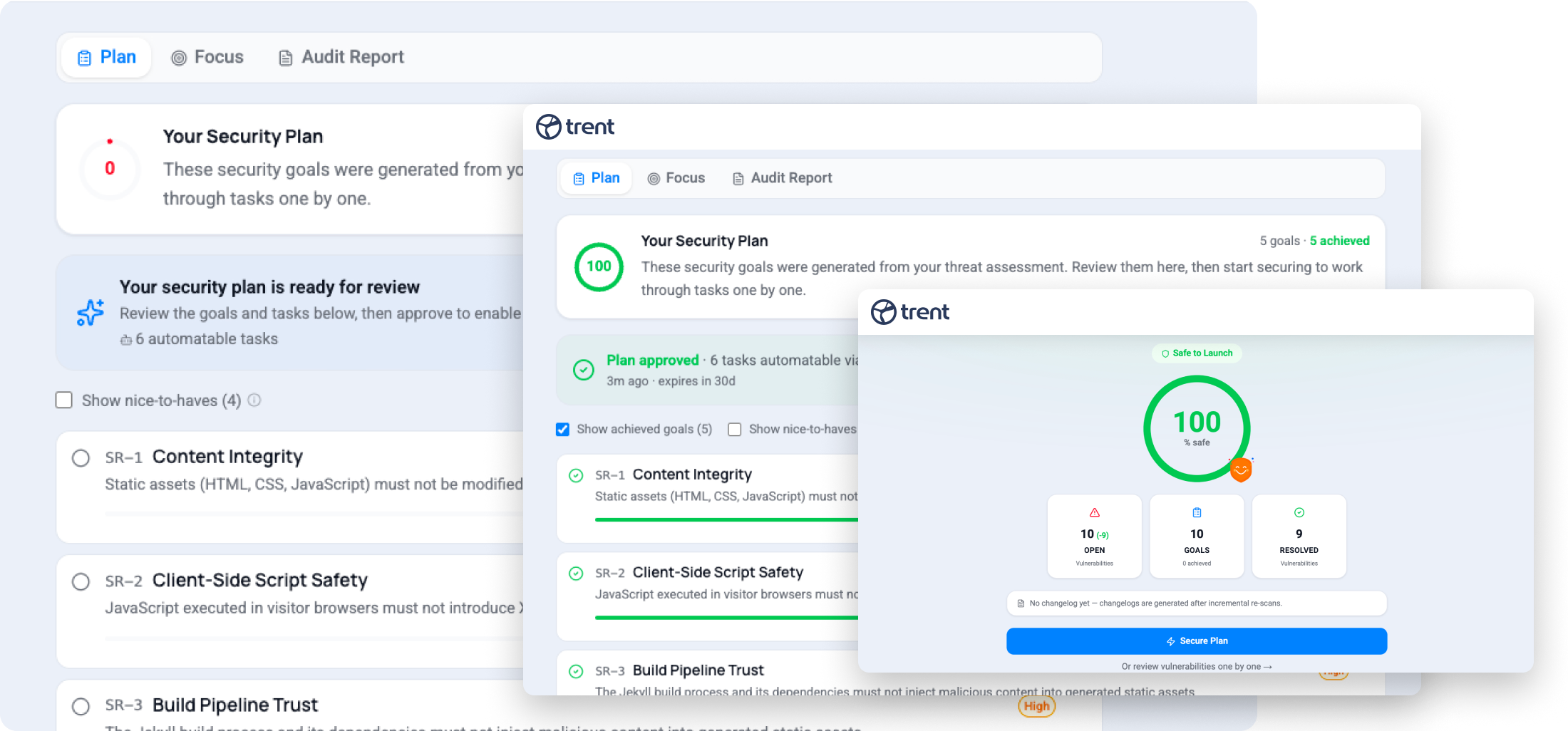
Your AppSec Tools Scan Code. Your AI App Makes Decisions.
Traditional tools focus on scanning code after it’s written, catching CVEs, flagging insecure dependencies, spotting known patterns, but that’s not the same as understanding whether your AI application is actually secure. The gap between “no known code vulnerabilities” and “secure AI application” is where risk compounds.

A single LLM call can access external data, call third-party services, modify databases, and trigger downstream actions, all from a single prompt. Prompt injection, tool misuse, data exfiltration through agent chains, your SAST/DAST tools are blind to all of it.

Traditional scanners, firewalls, and SAST/DAST tools are blind to the threats agentic systems create because they were designed for a world where software does exactly what it’s told. Your AI application reasons, plans, and acts; different threat model entirely.

Function calling and tool access give your AI application capabilities your security team didn’t explicitly approve. An agent with “update contact records” permission can be manipulated into deleting them. The permission was granted, nobody checked whether the action was appropriate.
Multiple Agents. One Continuous Loop. Applied to Your AI Application.
Trent’s specialized agents work in continuous loops across your environment: Scanning Agents find what matters, Judging Agents prioritize based on real risk, Mitigation Agents resolve issues and validate fixes, and Evaluation Agents assess your overall posture and forecast where risk will emerge next. Each cycle compounds intelligence, so your security gets sharper, faster, and more precise over time.
This agent analyzes your code, agent definitions, and system architecture to develop a deep understanding of your AI application and its workflows. It finds the threats that matter in your specific environment.

Not everything the scan finds is a real problem. The judgement agent prioritizes based on real risk rather than static rules. That means you focus on what actually matters for your application.
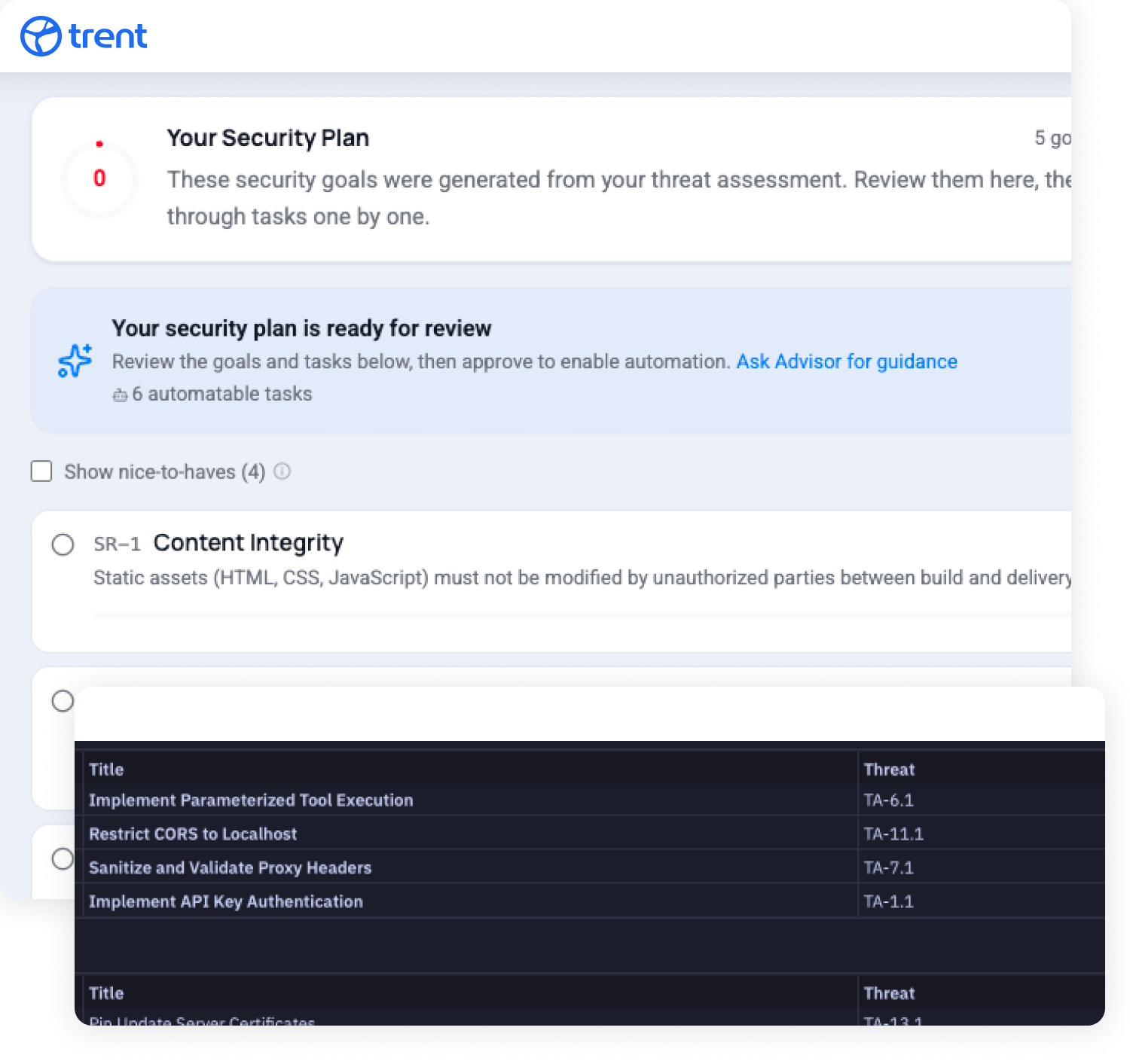
Trent helps you tackle identified threats with clear plans, detailed tasks, and ready-to-use remediation guidance your team can act on immediately.

As new agents are deployed or code changes and as your architecture evolves, Trent continuously re-scans, re-judges, re-mitigates, and re-evaluates, keeping your security current without a single human in the loop. Each cycle builds on the last.

Connect Your AI Application.

Connect your source code repository, agent definitions, or design documents. Trent begins analyzing your AI application’s architecture and workflows.

Receive a prioritized security assessment grounded in your specific application, its AI components, and your business requirements. Provide additional context at any time to sharpen the analysis.

As you ship new features, update models, or connect new tools, Trent continuously re-scans, re-judges, re-mitigates, and re-evaluates. Your security stays current without manual intervention.


See What Your AppSec Tools Miss.
Your AI application has risks your existing security stack was never designed to find. Connect your repo and find out.
FAQs
What is AI application security?
AI application security addresses the new threat surfaces created when AI agents call APIs, chain tools, and act on behalf of users. Traditional application security catches code-level issues. AI application security catches the risks that arise when your application reasons, plans, and acts autonomously.
How is Trent different from traditional AppSec tools?
Traditional tools scan code for known vulnerabilities. They can’t reason about agent behavior, multi-step autonomy, or the new threat surfaces your AI application creates. Trent’s agents work in continuous loops, scanning, judging, mitigating, and evaluating, to develop a deep understanding of your system architecture and agentic workflows.
What kinds of threats does Trent address?
The new categories of risk that agentic systems introduce: prompt injection, tool misuse, unintended autonomous actions, data exfiltration through agent chains, and privilege escalation across interconnected agents. These align with the OWASP Top 10 for LLM Applications.
How does this relate to the OWASP Top 10 for LLMs?
The threats Trent addresses align with the OWASP Top 10 for LLM Applications. Trent prioritizes based on the actual impact to your specific application and environment, not just by OWASP category.
Do I need to give Trent access to my source code?
You can start with a URL-only assessment that analyzes your application from the outside. For deeper analysis, connect your source code repository, agent definitions, or design documents. You can also provide additional context at any time, design documents, product specifications, compliance requirements, or technical constraints to sharpen the assessment further. You control what level of access to provide.
How is this different from AI Security Posture Management (AI-SPM)?
AI-SPM manages your security posture across all your AI systems over time. AI Application Security secures the specific AI application you’re building. Think of AI-SPM as the ongoing view across your estate. AI Application Security as the assessment of the specific application you’re shipping.