
What Is AI-SPM (AI Security Posture Management)?


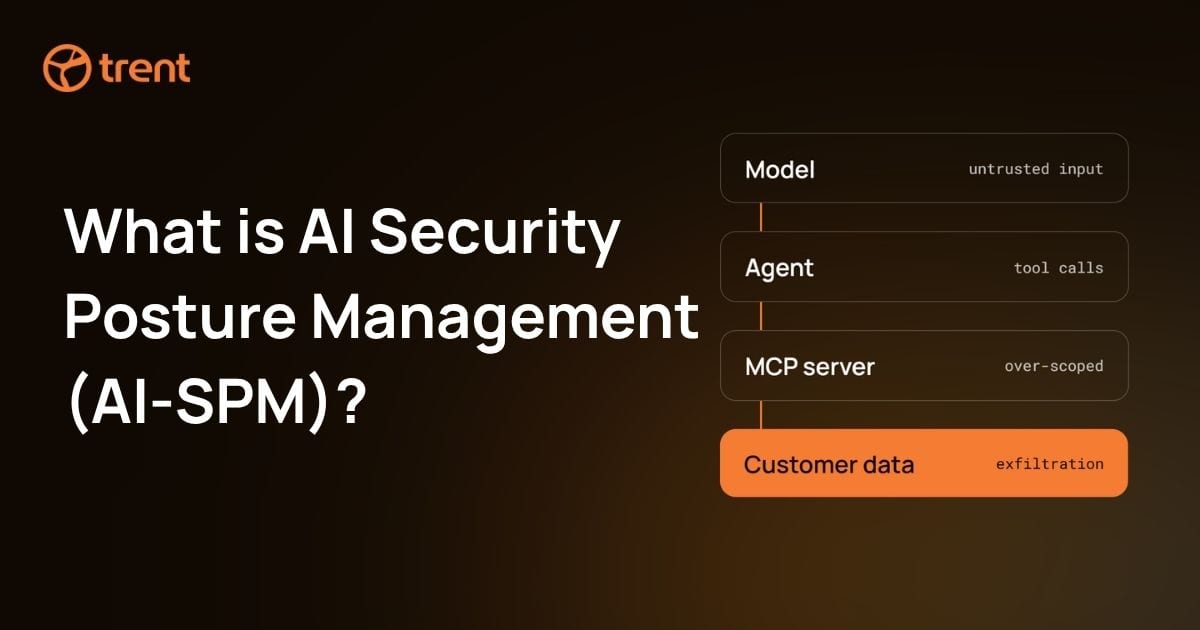
AI-SPM (AI Security Posture Management) continuously discovers, monitors and secures AI models, data pipelines, agents, and the APIs around them.
What it protects:
- Models and artifacts: hosted and self-run models, weights, notebooks, AI packages.
- Training and inference data: what goes in, what comes out, where sensitive data ends up.
- Identities and API keys: the service accounts, tokens, and permissions AI runs with.
- Shadow AI: models, agents, and MCP servers nobody approved.
“Secures” here means finding, scoring, and fixing weak configuration and access; some vendors also bundle runtime defenses. It covers the AI you build and run; governing staff, use of chatbots, and SaaS copilots is a separate job, whatever the vendor calls it. Vendors sell AI-SPM as a dashboard. It works better as a practice: know your AI assets, score their posture, fix what is weak.
What does AI-SPM cover?
AI-SPM products typically cover some mix of five jobs: an inventory of your AI assets (models, agents, skills, MCP servers), the permissions each one holds, the data paths between them, a posture score, and drift over time. Some vendors call the inventory an AI bill of materials (AI-BOM).
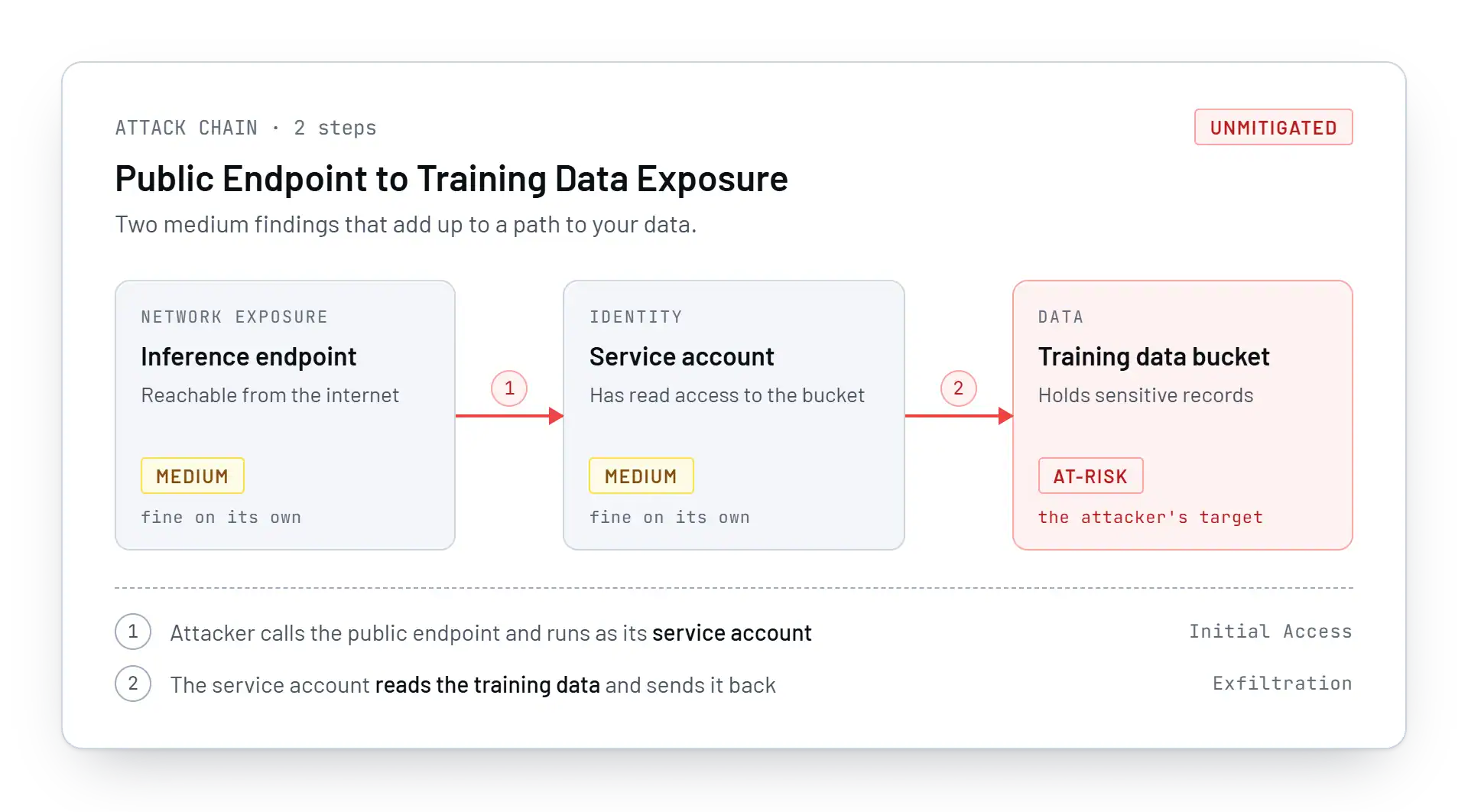
Take a public inference endpoint whose service account can read a bucket of sensitive training data. Neither finding is critical alone, and together they are a path to your data.
Most of the AI-SPM product pages we reviewed start from the cloud account, and repo coverage varies by vendor. Much of your AI now lives in application code: agent frameworks, MCP server configs, LLM SDK calls, AI-written commits. That is shadow AI in your codebase, and posture starts in the repo as well as the cloud. Some vendors already read the repo: Snyk Evo AI-SPM scans the repositories you import for the AI assets in your code.
Trent is not another AI-SPM dashboard or scanner. It is an AI Security Engineer that works alongside them all. It starts in your repo and pulls in context from the security tools your team already uses. It reconstructs the architecture from the real code, then inventories the whole system: API services, databases, object storage and networking, plus the AI layer on top (agents, tools and MCP servers), and tags each by what it can actually do, such as Read, Write, Execute and Egress. It draws the capability graph and traces attack chains through your real components, mapped to MITRE ATLAS.
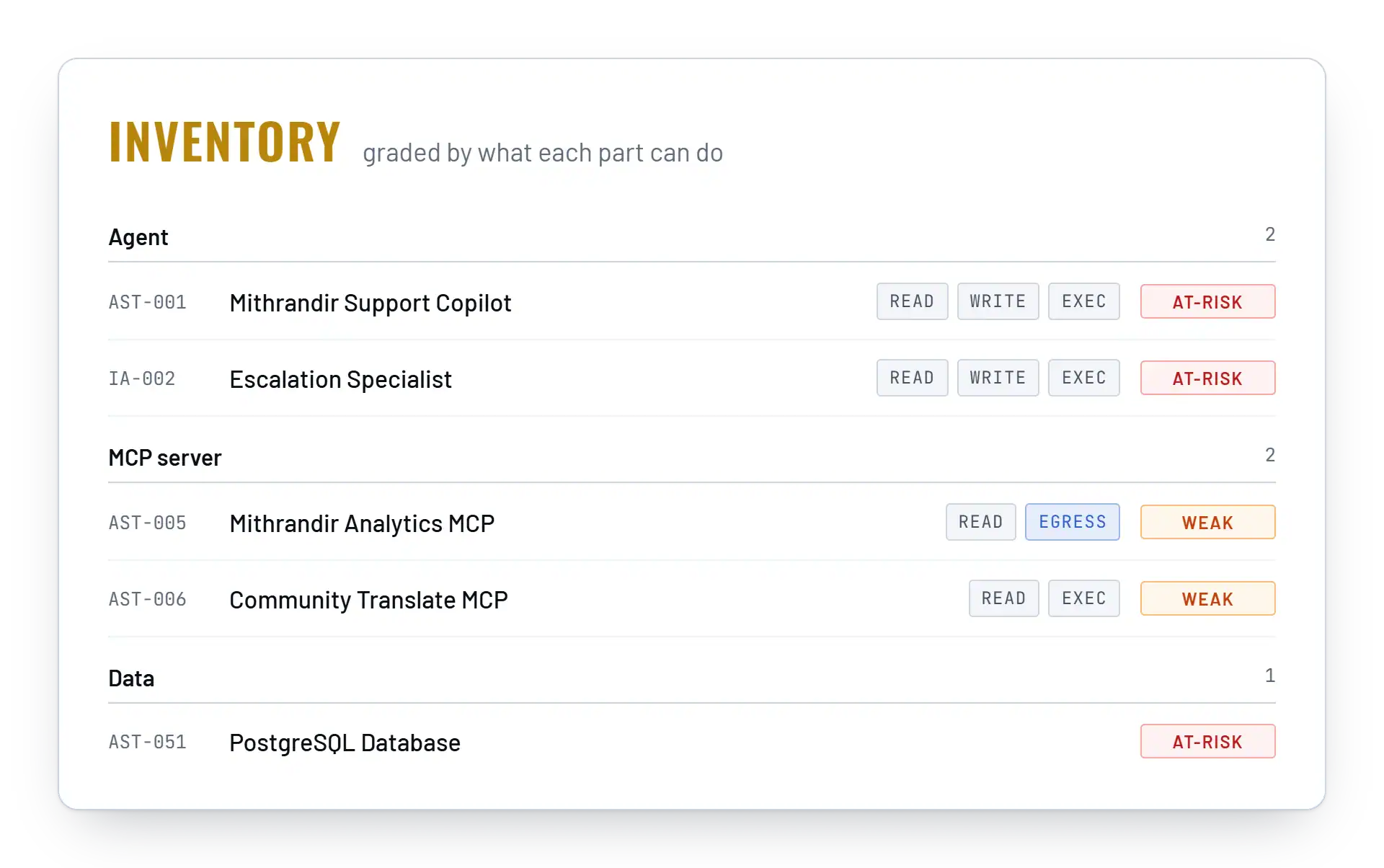
A list tells you what is there. The capability graph tells you which agent can read customer data and also reach the internet, the path an attacker wants. Trent recommends the fix, often as a ready-to-run prompt for your coding assistant. Your team decides, your coding agent applies it, and a re-scan confirms the fix landed. If a later change breaks it again, Trent reopens it. Also, Trent is not a WAF, does no runtime blocking, is not a pentest service, and never changes your code itself.
See the attack chain, not just the bug
Trent shows how findings connect into a real path, and which single fix breaks it.
AI-SPM vs. CSPM vs. DSPM vs. ASPM
Cloud security posture management (CSPM) checks how the cloud is configured. Data security posture management (DSPM) finds and protects sensitive data. Application security posture management (ASPM) pulls application risk together across the software lifecycle and ranks it. AI-SPM inventories and scores the AI layer, the part your CSPM may not see.
| AI-SPM | CSPM | DSPM | ASPM | |
|---|---|---|---|---|
| Asks about | Which AI assets exist, how they are set up, what they can reach, which risks are exploitable | Cloud resource settings, IAM and network exposure | Sensitive data: where it lives, who can access it, how it is exposed | Application risk pulled together from many tools and ranked |
| Main inputs | Cloud AI services, models, pipelines, agents and connected tools, depending on product scope | IaaS and PaaS configuration | Data stores and classification | SAST, SCA, DAST and secrets findings, plus software inventory |
| Example risk | Unapproved model or agent; over-permissioned AI service account; exposed sensitive training data | Public storage bucket; open security group | Customer records in an unmanaged store | The same flaw reported by three tools, none prioritized |
| Where the name comes from | Wiz product launch, November 2023; Wiz says it coined the term | Commonly credited to Gartner | Commonly credited to Gartner, around 2022 | Commonly credited to Gartner, around 2023 |
How it differs from the two closest:
- vs CSPM: baseline CSPM sees cloud resources, but it may not know which one is a model endpoint or what an agent can do with it. Some CSPMs now include AI posture, such as Microsoft Defender CSPM.
- vs DSPM: DSPM follows the data. AI-SPM follows the models and agents that use it.
Where the term AI-SPM comes from
AI-SPM is a vendor label. Wiz launched “Wiz for AI Security (AI-SPM)” on November 16, 2023, and says it coined the term. Palo Alto Networks announced Prisma Cloud AI-SPM in May 2024, and CrowdStrike followed in September 2024.
As of October 2026, we found no public Gartner market report for AI-SPM; in Gartner’s open material it appears as one capability inside AI security research. KuppingerCole analyst Alexei Balaganski argued in June 2026 that CSPM, DSPM, SSPM and AI-SPM are “one capability aimed at different targets,” and advised buyers to map products to the capabilities they need, not to the acronym. In practitioner forums you will see slices of it under other names: shadow AI for unsanctioned tools, shadow MCP or agent inventory for components in code.
How to start AI-SPM before choosing a product
Start with an inventory, then score the program around it. Trent’s AI Security Maturity Model (ASMM) scores your AI security program, not individual assets. An AI-SPM product checks the assets themselves.
The ASMM covers six domains (Govern, Identify, Protect, Detect, Respond, Recover), with levels adapted from the NIST CSF Tiers, from Partial to Adaptive. Its self-assessment asks for proof behind every strong answer. In its own words: “A self-assessment reflects what you report. The useful part is seeing which answers you could actually show.”
Three first steps:
- Search manifests and configs for LLM SDKs and MCP servers.
- List the service accounts and API keys your AI runs with.
- Take the ASMM self-assessment (12 questions across all six domains) and mark the answers you could not prove.
AI-SPM tools and vendors
Most vendors below package AI-SPM inside a larger platform (cloud, data, or code security); standalone products exist too.
- Wiz (part of Google Cloud since March 2026, still multicloud): cloud AI services, models and SDKs, now including agents and MCP connections. Good fit if your AI spans several clouds.
- Palo Alto Networks: Cortex Cloud AI-SPM (formerly Prisma Cloud AI-SPM) for posture. Prisma AIRS adds runtime defenses, plus model scanning and red teaming from Protect AI, acquired in July 2025.
- CrowdStrike: AI-SPM in Falcon Cloud Security: cloud AI services, AI packages in container images, IaC.
- Zscaler: AI-SPM tied to its DSPM, mapping data to the models that use it. Good fit if your worry is what data your models touch.
- Orca Security: agentless inventory of cloud AI models and packages, plus misconfiguration and data exposure checks.
- Tenable: AI-SPM in Tenable Cloud Security, plus AI Exposure for SaaS copilots.
- Microsoft: AI posture in the Defender CSPM plan. Since July 1, 2026, agent-level posture needs an Agent 365 license. Already on Defender CSPM? Check what it covers before buying more.
- Snyk: Evo AI-SPM, an AI-BOM of the AI assets in the repositories you import, plus model risk scores and policy checks.
- Trent: the AI Security Engineer above, working from your code and from context in the security tools you already use.
If your AI is mostly managed cloud services spread across accounts, a cloud AI-SPM such as Wiz, Palo Alto Networks or Microsoft Defender CSPM is the better fit.
Several vendors above also bundle runtime defenses or red teaming; Trent does neither. Our AI security posture management solution page shows how Trent approaches AI-SPM for agentic systems.
The short version
AI-SPM is a practice before it is a product: inventory, score, fix, repeat. Trent starts in the repo and pulls in context from the security tools your team already uses, as an AI Security Engineer that shows you what your agents can reach and recommends the fix.
Reviewed by Zack Rossman, Head of Engineering at Trent AI
What can your agents actually reach?
Trent maps each agent to its tools and data, then traces the attack chains a prompt injection could follow.
Request accessFAQ
What tools are available for AI-SPM?
Three groups: cloud security platforms such as Wiz, Palo Alto Networks and Microsoft, data security products extending into AI, and code-focused tools such as Snyk Evo AI-SPM that read AI in repositories. Pick by where your AI actually runs.
What is the difference between AI-SPM and CSPM?
CSPM checks cloud configuration. AI-SPM checks the AI assets on top of it: which models and agents exist and what they can reach.
What is the difference between AI-SPM and DSPM?
DSPM follows sensitive data. AI-SPM follows the models and agents that read and write it. Run both when training or retrieval data is sensitive.
Do I need AI-SPM if I already have CSPM?
It depends on what your CSPM covers. Check whether it finds AI services, models, agents, their identities, data paths and endpoints, and whether it sees AI in your code, not only your cloud.
Who are the leaders in AI-SPM?
As of October 2026, we found no neutral, verified leaderboard. Compare vendors on cloud coverage, code coverage, identity mapping, data lineage, runtime defenses, and how they prioritize and track fixes.