SAST vs DAST: The Difference, and When You Need Each

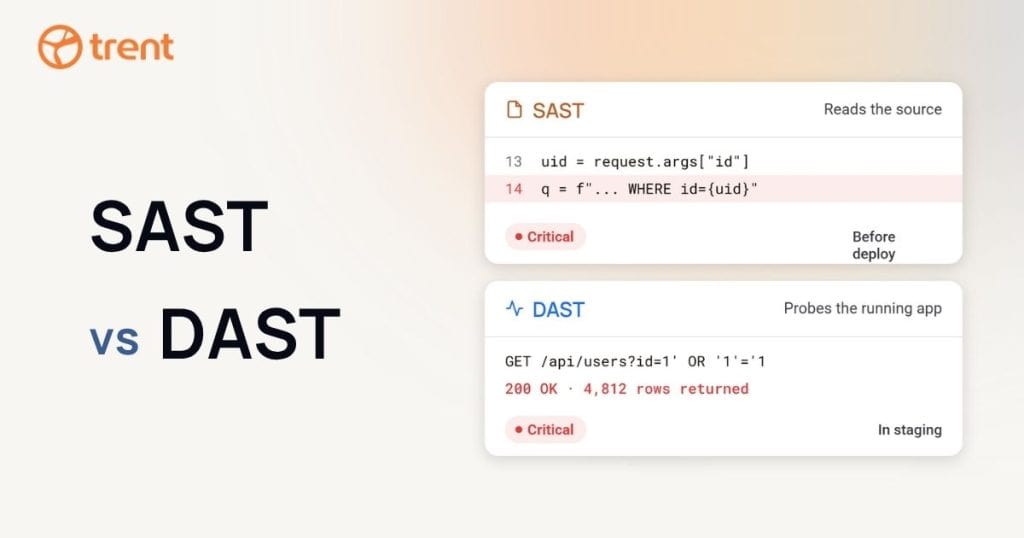
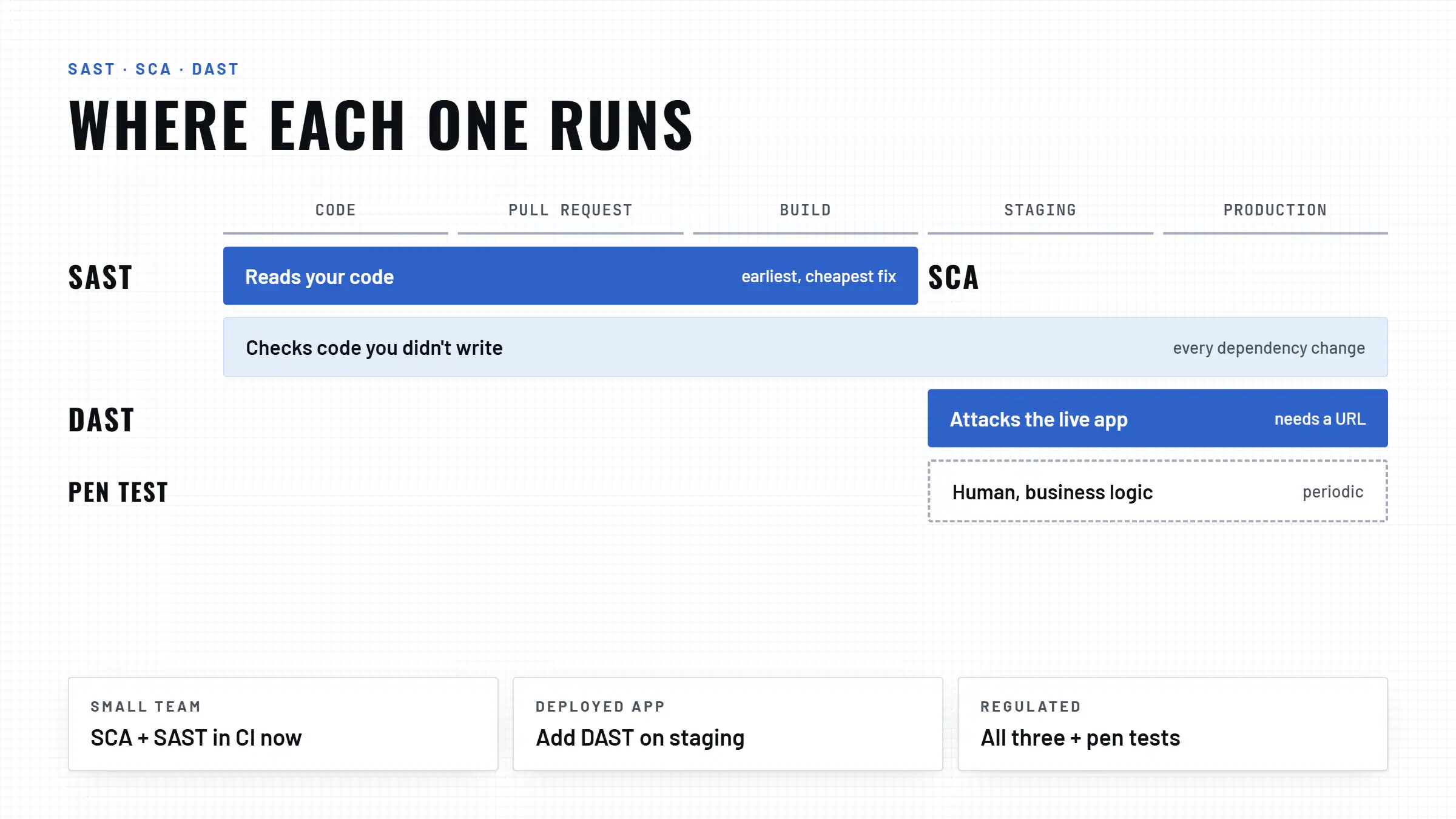
SAST reads your code from the inside; DAST attacks the running app from the outside. Most teams end up running both, plus software composition analysis (SCA) for the dependencies neither of them wrote. Nothing mandates an order: NIST’s Secure Software Development Framework says its practice sequence “is not intended to imply the sequence of implementation.” SCA and SAST usually land earliest; DAST joins once you have a deployed target. The order depends on what you have deployed.
- Approach: SAST is white box, and needs source, bytecode, or compiled code. DAST is black box, needs a running URL.
- Timing: SAST at commit and in CI. DAST against staging, pre-production, or authorized production.
- Noise: SAST findings need triage. DAST needs a running target and validation.
- What each finds: code-level flaws (SAST), runtime, configuration, and authentication behavior (DAST), known-vulnerable dependencies and, in some products, malicious packages (SCA).
AI-assisted review is a complementary layer, below. Our glossary covers static and dynamic analysis.
What SAST Is
Static application security testing analyzes “source code or compiled versions of code to help find security flaws” without running the application, in OWASP’s own wording. It runs in your IDE, at pull request, and in the build, strong on injection and known-bad patterns, with a candidate file and line.
OWASP states the limits: SAST is weak on authentication, access control, cryptography and configuration, and it “only allows such tools to automatically find a relatively small percentage of application security flaws.” That wording is long-standing: modern SAST catches many cryptography and hardcoded-credential patterns, while access control and business logic stay the real gap.
Chrome’s CVE-2019-13720, a use-after-free, illustrates the attack class SAST is built for, not a finding a SAST tool produced. Google Project Zero said static analysis could probably have found it.
What DAST Is
Dynamic application security testing scans the deployed application “normally from the outside,” in OWASP’s phrasing, against the surface it can reach and without source access. Coverage depends on authentication setup, crawl depth, JavaScript rendering and workflow state. You point it at staging, pre-production, or an authorized production target, and it reports runtime, configuration and authentication behavior the code alone does not show. On shared environments, use non-destructive settings and rate limits.
OWASP is direct about the limit: a dynamic scan “cannot cover 100% of the source code,” and the crawler misses endpoints it never reaches. DAST is language-agnostic, so it travels well across a mixed stack.
The MOVEit SQL injection, CVE-2023-34362, illustrates the attack class DAST is built for, not a DAST finding: CISA’s advisory describes attackers exploiting over HTTP against running instances.
SAST vs. DAST vs. SCA: Comparison Table
In many applications a large share of the tree is dependencies, so SCA belongs here.
| SAST | DAST | SCA | |
|---|---|---|---|
| What it looks at | Your source, bytecode or compiled code | The deployed app and its observable behavior | Direct and transitive dependencies, versions, licenses, known risk |
| When it runs | IDE, pull request, build | Staging, pre-production, authorized production scans | Every dependency change, build, release, and scheduled rescans as new advisories land |
| What it finds | Injection, unsafe patterns, taint flows | Runtime, configuration and authentication behavior, exposed endpoints | Known vulnerable, outdated or license-risk components and, in some products, suspicious or malicious packages |
| What it misses | Runtime configuration, deployment state, environment-dependent behavior | Unexercised code paths, undiscovered endpoints, anything only visible in source | First-party logic and implementation flaws |
| Noise | Rule and data-flow findings need triage | Needs validation; noise varies with crawling, auth and setup | Version matches can be false positives too (affected ranges, backports, optional dependencies); reachability is prioritization evidence, not proof |
| Cost | Cheap to run; cheaper to fix because it fires earliest | Needs an environment and credentials; findings surface later | Cheap to run; the work is deciding what to upgrade |
| CI fit | Native | Needs CI to provision a target and test credentials | Native, from manifests, lockfiles and SBOMs |
| Example tools | Semgrep or Opengrep, SonarQube Community Build, CodeQL | ZAP by Checkmarx, Burp Suite Professional and Burp Suite DAST, Nuclei (template-based, DAST-adjacent) | Dependabot, Snyk Open Source, Trivy |
Almost every published false-positive rate is a vendor figure, and the closest thing to a neutral reference is the OWASP Benchmark, which is synthetic.
False positives cost more than time
Every false alarm teaches developers to ignore the next one. Trent checks each finding against how your application actually works before it reaches them.
Examples of SAST, DAST, and SCA Tools
Common SAST and DAST tools, plus SCA, with what changed for each.
SAST. Semgrep’s engine stayed LGPL 2.1, its maintained rules moved to the Semgrep Rules License in December 2024, and Opengrep is the community fork that followed. SonarQube’s free edition became SonarQube Community Build in December 2024; it analyzes the main branch and pull requests that target it, while advanced taint SAST is a paid tier. CodeQL’s query packs are MIT, but the CLI runs under GitHub’s own terms: free for open-source code, while closed-source analysis needs GitHub Code Security or a commercial license.
DAST. ZAP left OWASP in September 2023. Checkmarx has funded the core team since September 2024 and supports rather than owns the project, still Apache 2.0, now branded ZAP by Checkmarx. Burp Suite Community ships no automated scanner; Professional and Burp Suite DAST do. Nuclei (ProjectDiscovery, MIT) is a template scanner; it does not crawl or model application state like a DAST tool.
SCA. Dependabot is built into GitHub, Snyk Open Source has a free tier with test caps, and Trivy is Apache 2.0 and reaches beyond SCA into misconfiguration, secrets and containers. On 19 March 2026 a malicious Trivy v0.69.4 shipped, 76 of 77 trivy-action tags and all setup-trivy tags were repointed to credential-stealing code, and malicious v0.69.5 and v0.69.6 Docker images followed on 22 March. Patched action versions are trivy-action 0.35.0 and setup-trivy 0.2.6. CVE-2021-44228 (Log4Shell) is the manifest-level version match SCA answers; CVE-2024-3094 (XZ Utils) belongs to container or OS-image scanning, Trivy on images.
When to Pick Which, by Team Size and Stack
Pick by what you have deployed and by your stack. Small team on one repo: SCA and SAST in CI now, DAST once you have a staging URL.
If you have a product team and a deployed app, run all three: DAST scheduled against staging, and authorized production scans only under change control.
Regulated or enterprise: all three plus a periodic penetration test, and a compliance mapping naming each one, a common control pattern rather than a universal requirement. OWASP SAMM lists SAST, DAST, and SCA without prescribing an order.
Compiled, strongly typed languages get more from SAST taint analysis. API-heavy apps get more from DAST. Anything with a package manager needs SCA early. If you are buying under audit pressure with a multi-language stack: no single tool covers everything, and we make no vendor recommendation for the three scanner categories.
DAST vs. Penetration Test
DAST is automated and repeatable; a penetration test is a human engagement that chains findings and tests business logic. You run DAST against every release you care about; a pentest runs on a slower cadence.
OWASP’s Web Security Testing Guide puts the gap plainly: automated tools “lack the application-specific context needed to detect deeper flaws.” NIST SP 800-115 describes assessors who “mimic real-world attacks”; chaining those findings is our own shorthand.
Book a pentest when the risk sits in business logic, which a crawler cannot map.
Where AI-assisted Review Fits
AI-assisted review is a complementary layer, in two shapes: AI on top of a scanner, and an LLM reading your pull request. An r/devsecops thread on 10 September 2026 asked it directly: “How do you evaluate a SAST platform in 2026 now that AI writes half the code?”
AI on top of your SAST (Copilot Autofix, Semgrep Assistant, Snyk DeepCode AI) triages and fixes what the scanner already found. A June 2025 paper, arXiv 2506.16899, reports that some models, with chain-of-thought prompting and held to zero lost true positives, removed about 62.5% of false positives on the synthetic OWASP Benchmark, and the best single model removed 33.85% on a real-world set across five SAST tools. That is AI filtering an existing SAST report, not finding vulnerabilities itself.
LLM review of your pull request (CodeRabbit Security, Claude Code’s review action, Cursor Bugbot, and an AI security engineer such as Trent, your AI Security Engineer) can reason about intent, data flow and architecture when it is given that context, probabilistically rather than by rule. An independent August 2025 benchmark, arXiv 2508.04448, ran GPT-4.1, Mistral Large and DeepSeek V3 against SonarQube, CodeQL and Snyk Code on ten real C# projects with 63 planted vulnerabilities. Mean F1 was 0.797, 0.753 and 0.750 for the LLMs against 0.260, 0.386 and 0.546 for the static tools. The paper’s caveats: one language, ten projects, more false positives, line-level mislocation by every LLM, and the planted issues include hardcoded secrets and outdated dependencies, so the static tools were also scored on SCA-class items.
Our own CWE-Bench run on 28 real Java CVEs points the same direction on recall. Claude Code hit 65% on Category Detection Rate (right class somewhere in the repo) and 8.7% on Detection Rate (right class at the labelled vulnerable location), while Trent hit 25% detection with a category rate close to Claude Code’s; Semgrep hit 42.9% category and about 3.6% detection, CodeQL about 3.6% detection. Recall only, since the post declines to report precision.
From r/devsecops on 11 September 2026: a change “no scanner recognizes” was asserted safe in a commit message, and the team could not verify it. That intent-level question is the one agentic AI security takes on through automated assessment and continuous review.
IAST instruments the application during your tests, in Gartner’s framing. RASP sits inside the running application and defends it at run time, which is protection, not testing. Trent does neither.
SAST, DAST, and software composition analysis are not obsolete, and an AI security engineer does not replace them. Trent is not a DAST scanner and not a penetration testing service.
Running all Three, Plus AI Review
You eventually want all three: SCA for the code you did not write, SAST for the code you did, DAST for the behavior only a running app shows. AI-assisted review is a complementary layer, reading the intent behind a change the other three were never built to read. Trent, your AI Security Engineer, works alongside them, not in place of them.
Reviewed by Zack Rossman Head of Engineering at Trent AI
Which of these findings are actually real?
Bring in the results from your security tools. Trent checks each one against how your application really works.
From your security tools
After Trent
Works with any security tool that exports SARIF.
FAQ
What is the difference between SAST and DAST?
SAST reads your code from the inside; DAST attacks the running app from the outside. SAST needs your source and fires at commit; DAST needs a running target. SCA is the third layer, covering your dependencies.
Is SonarQube DAST or SAST?
SonarQube is SAST, not DAST. It analyzes your source without running the application. Community Build is free and analyzes the main branch and pull requests that target it; advanced taint SAST is a paid tier. Dynamic scanning needs a separate DAST tool.
What are examples of SAST tools?
Semgrep or Opengrep, SonarQube Community Build, and CodeQL. Semgrep’s engine stayed LGPL 2.1 while its maintained rules moved to the Semgrep Rules License in December 2024; CodeQL’s queries are MIT, and closed-source analysis needs a GitHub Code Security or commercial license.
What are the top DAST tools?
ZAP by Checkmarx, Burp Suite Professional, Burp Suite DAST, and Nuclei are common DAST tools you will encounter. Burp Suite Community ships no automated scanner, so check the edition before you plan a pipeline around it.
Do I need SAST if I already have DAST?
Yes, because they find different things. DAST cannot see code paths it never exercises or endpoints its crawler never reaches, and SAST cannot see runtime and configuration behavior. The “what it misses” row covers it.