
AI Security Assessment for the Apps and Agents You Build
Trent is your AI Security Engineer. It runs a continuous AI security assessment of the app or agent you are building. It reads the real code and configuration, maps what every agent, tool, skill and MCP server can do, and traces the attack chains that matter for your business. Think of it as AI security testing and an AI vulnerability assessment that never goes stale: findings arrive ranked, grounded in your code and your team’s own context, and tracked until each fix ships.
No pentest to schedule and no audit to wait for. Connect your repository, add the design docs and security findings you already have, and get your first AI app security assessment as a short, ranked plan your coding assistant can start on.
Cybersecurity Stars Awards 2026 Winner 🏆 The Hacker News 2026
Your AI App Was Never Assessed for What It Can Actually Do
Most security checks were built for software that does exactly what it is told. An AI app or agent reads untrusted input, decides what to do, and then calls tools that write data, run commands or send data out. Agentic AI security testing has to follow that whole path, not just flag a line of code. Most teams have never had that done, and a one-off review goes out of date with the next release.

An agent with access to private data, exposure to untrusted content and a way to send data out is one prompt injection away from a leak. No single file looks wrong. The danger is the combination, and you only see it by mapping every tool and permission together.

Your existing security tools flag patterns and outdated libraries. They do not know what your app is for, who uses it, or which data would hurt to lose. So you get a long list and no idea which three items to fix this week.

A security review done before launch describes the app you had then. Every new tool, model, MCP server or prompt change moves the risk. By the next release, the report describes a different system.
Understand. Plan. Secure. An Assessment That Keeps Up With Your Code.
Trent works the way an experienced security engineer on your team would. It learns the system first, works out what could really go wrong, and then helps your team fix it, one finding at a time.
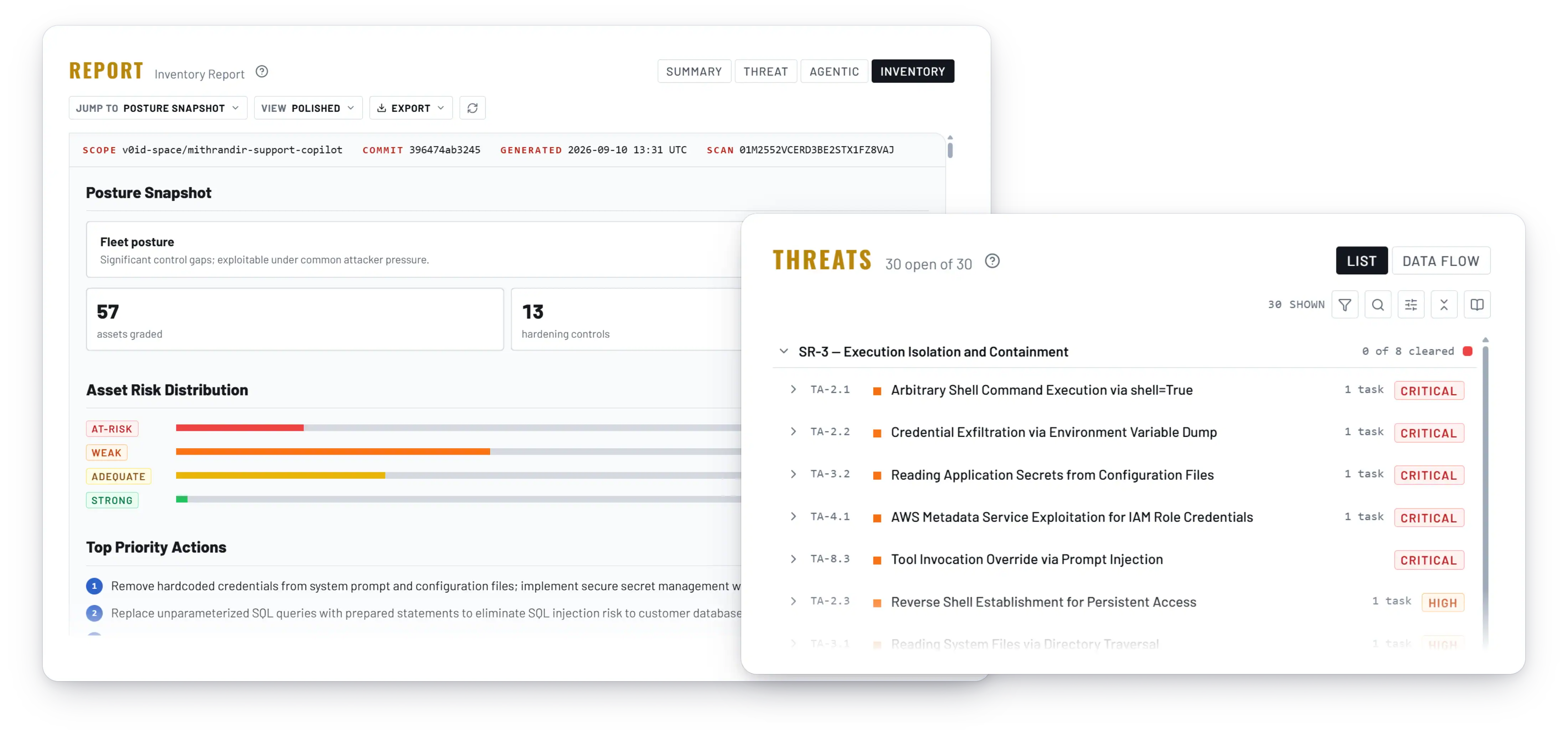
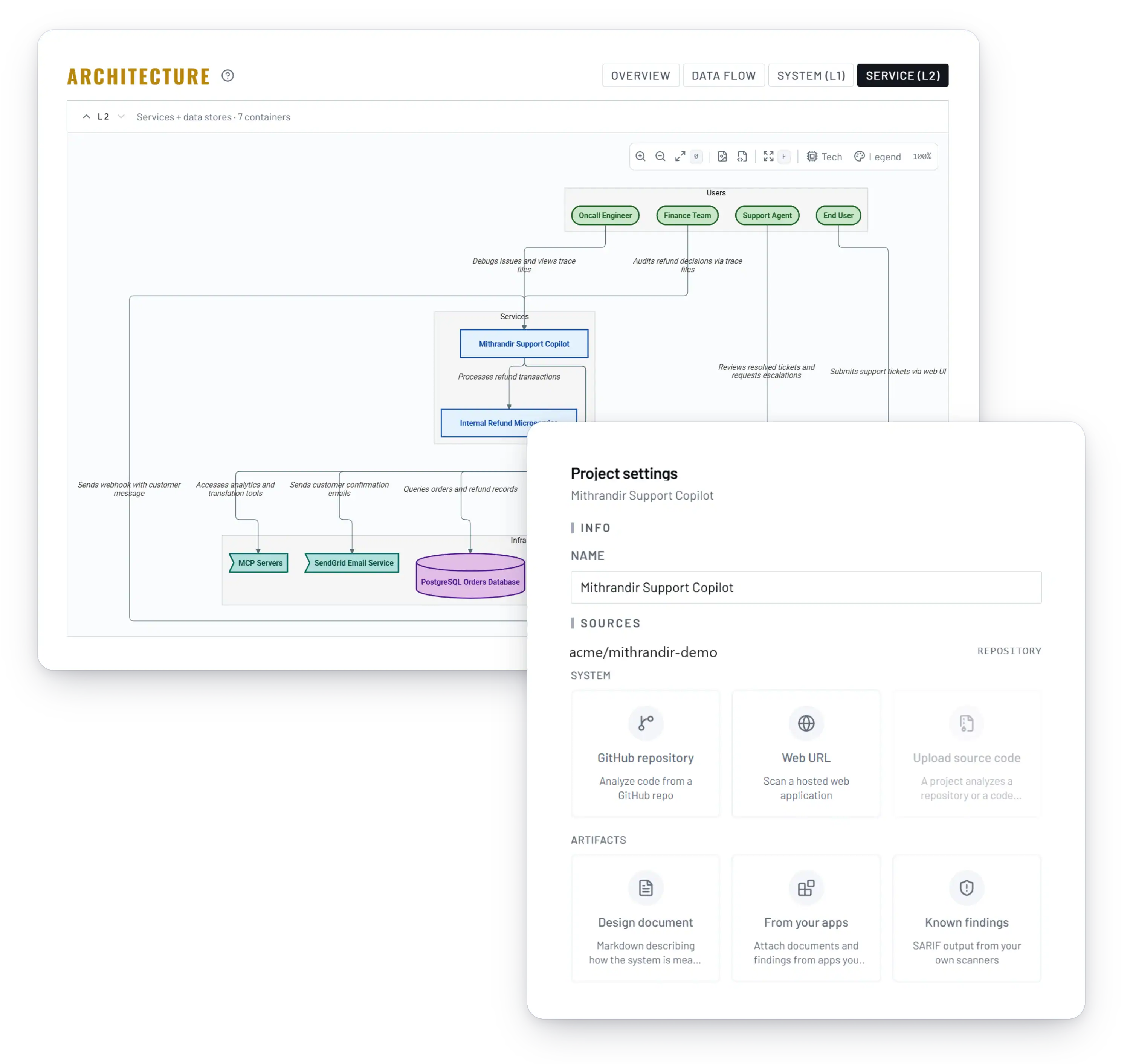
Trent reads your code and configuration and reconstructs the architecture. It inventories every component in the system, including every agent, tool, skill and MCP server, tags what each one can do (read, write, execute or send data out), and draws a data flow diagram of how data moves between them. It also reads the security context you already have, such as design docs and findings from your security tools through SARIF upload or native connectors. Every finding cites the source it relied on.
Trent traces attack chains through the real code, including AI-native risks like prompt injection, tool misuse, and an agent that holds private data, reads untrusted input and can send data out. It walks each chain to the line of code, then ranks what matters for this business, so the top of the list is what you fix first.

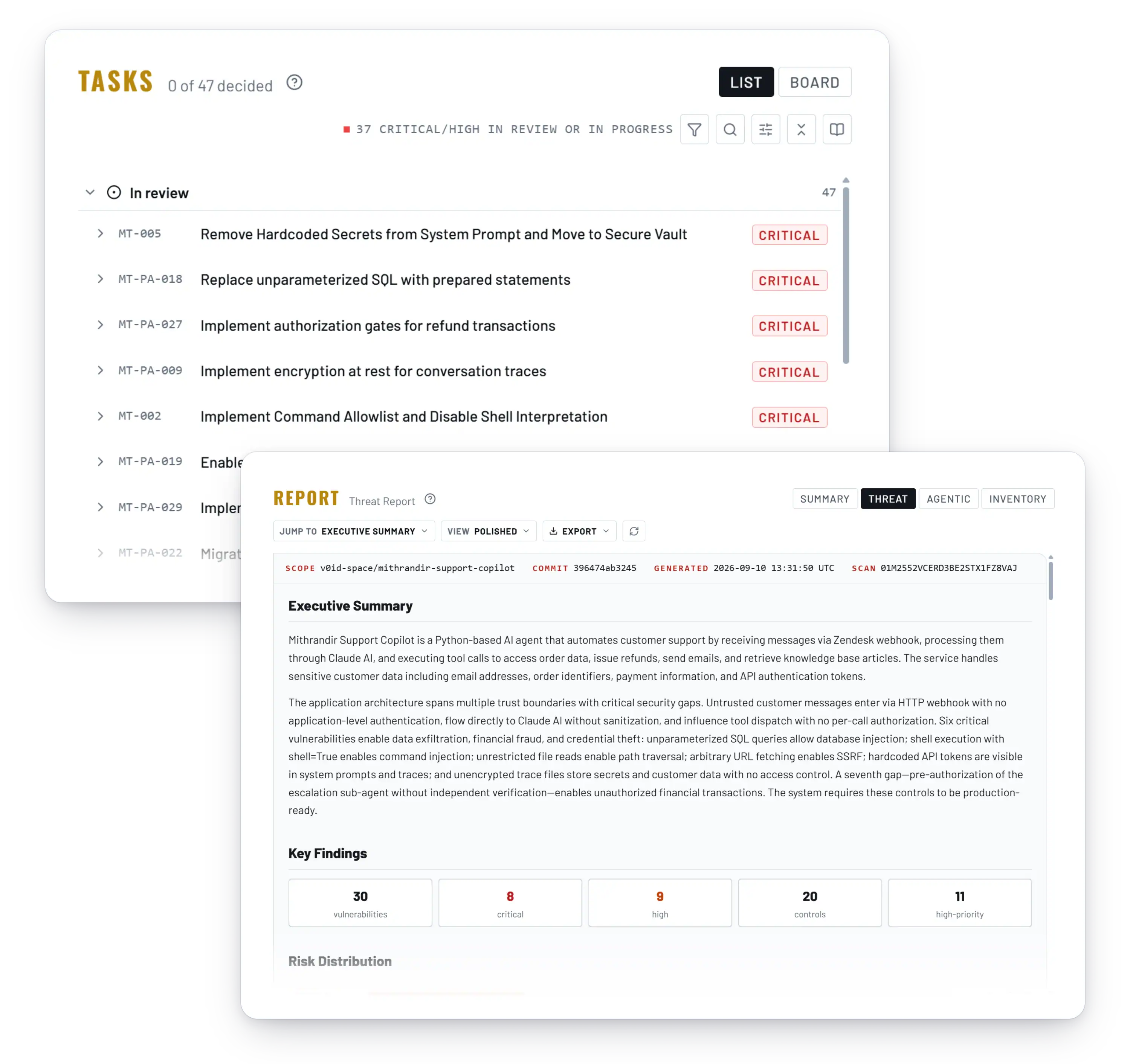
For each finding, Trent writes the fix as a ready-to-run prompt for your coding assistant, such as Claude Code, Codex or Cursor. Your team runs it, and Trent tracks which fixes are delivered and which are still open. Trent never changes code itself. As the code changes, Trent re-assesses, so the ranked list stays current.
What an AI Security Assessment Covers
Whether you call it LLM security testing or an AI agent security audit, the question is the same: what can this system be tricked into doing, and how bad would it be? Trent checks the parts of an AI app where that answer lives.
Full system inventory
Services, databases and other software components, plus every agent, tool, skill and MCP server, with a data flow diagram that shows how data moves between them.
Prompt injection paths
Where untrusted content (web pages, emails, files, tool output) reaches a model that can act on it.
Tool misuse
Tools that can be steered into actions nobody meant to allow, like deleting records instead of updating them.
Risky combinations
Private data plus untrusted input plus a way to send data out, in one agent or across several.
Permissions
Tools, tokens and service accounts that have more access than the job needs.
Authorization and business logic
Whether the wrong user can reach the wrong data through the app or through the agent.
Secrets and configuration
Keys in code, unsafe defaults, and agent setup files such as instruction files, hooks and allowlists.
Your existing findings, in context
Results from your security tools, re-ranked against how your app actually works.
Different checks answer different questions. Here is where a continuous AI security assessment fits.
| Approach | What it answers | How often | What you get |
|---|---|---|---|
| Continuous AI security assessment (Trent) | Can this AI app or agent be abused, and what should we fix first? | Every time the code changes | Ranked findings grounded in your code and context, attack chains walked to the line, fix prompts, fix tracking |
| AI security scanner or code scanning tool | Does the code match known bad patterns or vulnerable libraries? | On each scan | A list of pattern matches to triage yourself |
| Penetration test | Can a tester break in during the test window? | Once or twice a year | A report on the system as it was during the test |
| Maturity self-assessment | How mature is our security program overall? | Yearly or quarterly | A program score and gaps |
Trent works alongside the security tools you already run and uses their findings as input. It is not a pentest service or a compliance audit.
What You Get From Each Assessment
- A short, ranked list of findings, ordered by risk to your business, not by count.
- Each finding with the attack chain, the line of code, and the source Trent relied on.
- Mapping to MITRE ATLAS and the OWASP Top 10 for LLM Applications.
- A ready-to-run fix prompt for your coding assistant, tracked until the fix ships.
- The threat model, posture report, data flow diagram, and architecture and agent diagrams, ready to share with leadership or a customer’s security review.
Your First Assessment Starts With Your Repo

Request access to Trent. Once you are in, create a project for the AI app or agent you want to assess.

Connect your repository, or install the Trent plugin in Claude Code or Codex and ask Trent to assess the security of your AI app from your session. Add design docs, and bring in findings from your security tools through SARIF upload or native connectors.

Get your ranked findings and fix prompts. Your team runs each fix, Trent tracks what is done, and every new commit gets assessed as you ship.


Built for Whoever Owns Security for Your AI Product
Security teams that are stretched
Your company is shipping AI features and agents faster than you can review them. Trent gives each one a real assessment, grounded in the code, so your time goes to the few findings that matter.
Teams with no security hire yet
A team of five, or the staff engineer who got stuck with security. Trent is the security engineer you have not hired yet: it explains each risk in plain terms and hands your coding assistant the fix.
Why Trent
An AI Security Engineer you can talk to, not a dashboard of alerts. Trent reads your real code, respects your team’s own context, and never changes your code itself.
Agentic AI Security Platform Leader, 2026 Cybersecurity Stars AwardsFind Out What Your AI App Can Be Tricked Into Doing
Your first AI security assessment gives you a ranked plan your team can start on the same day. From then on, Trent re-assesses as you ship.
FAQs
What is an AI security assessment?
An AI security assessment checks whether an AI app or agent can be abused, and how badly. It looks at what the system can do (the data it reads, the tools it calls, where it can send data) and at how an attacker could steer it, for example through prompt injection. Trent’s AI security assessments run continuously on your real code and rank findings by risk to your business.
Is Trent a pentest service or an AI security scanner?
Neither. A pentest is a person testing your system for a set window. An AI security scanner matches code against known patterns. Trent is your AI Security Engineer: it reads the code and configuration, maps how the system fits together, traces attack chains, and ranks what matters. It runs every time your code changes, and it uses findings from your security tools as input.
What does an AI agent security audit with Trent check?
Everything the app is built from, including every agent, tool, skill and MCP server. Trent maps what each piece can read, write, execute or send out, and draws a data flow diagram of how data moves between them. Then it looks for prompt injection paths, tool misuse, over-broad permissions, and risky combinations such as an agent with private data, untrusted input and a way to send data out. It also checks authorization, secrets and agent setup files.
How is this different from LLM security testing or red teaming?
LLM security testing and red teaming usually send attack prompts to a running model and see what comes back. Trent works from the inside: it reads the code and configuration, so it can show why an attack works and which line to change. For agentic AI security testing, that matters, because the risk sits in the tools and permissions around the model.
Do I need to give Trent my source code?
For an assessment of an AI app or agent, yes: Trent reads the code and configuration to trace real attack chains. You choose which repositories to connect. If you want to start without code access, a URL-based web application security assessment looks at your app from the outside.
Does Trent fix the vulnerabilities it finds?
Trent writes each fix as a ready-to-run prompt for your coding assistant, such as Claude Code, Codex or Cursor, and keeps track of which fixes have landed and which are still open. Your code only changes through your own tools.
Is this the same as the AI Security Maturity Model assessment?
No. The AI Security Maturity Model self-assessment scores your security program as a whole. This page is about assessing the security of one AI app or agent, in its code.