The Judgment Layer: Rethinking AI Safety for Agentic Systems

For the past several years, AI safety has largely been framed as an alignment problem. How do we ensure that models behave according to human intentions? How do we reduce hallucinations? How do we constrain unwanted behavior? Those are important questions, but they increasingly feel like yesterday’s questions.
Today’s AI systems are no longer isolated models answering prompts. They are becoming teams of collaborating agents that plan, reason, use tools, modify software, and increasingly execute real business workflows. As they become embedded in our organizations, AI safety stops being solely a machine learning problem and starts becoming an organizational one.
The challenge is no longer simply making an AI system produce the right answer. It is deciding who has the authority to decide when the answer matters, and this is what we discuss in this article.
AI Systems Are Beginning to Look Like Organizations
One of the most interesting developments in AI over the last year has been the rise of multi-agent systems. Rather than relying on a single model, today’s most capable systems increasingly divide work among specialized agents that critique one another, share context, and coordinate on complex tasks. This isn’t simply an engineering trick. It works because it mirrors something humans have been refining for centuries: collaboration.
In recent research, my colleagues and I have explored the idea that these systems succeed because they absorb patterns found throughout human organizations. Diverse perspectives, constructive disagreement, independent judgment, shared context, and mechanisms for correction improve both human decision-making and multi-agent AI systems.
Let’s look at why AI agents mirror organizations, and what that means for AI safety.
Organizations Already Know How to Manage Complexity
Long before large language models existed, organizational theorists were wrestling with a similar problem. How do you control a system that is simply too complex for any one individual to understand? One of the most influential answers came from Stafford Beer’s Viable Systems Model, developed in the 1970s. Its insight is remarkably simple.
Leadership can never process every piece of information flowing through an organization. If every operational detail reached the CEO, nothing useful would ever happen. Instead, organizations succeed because authority is distributed downward while information is filtered upward. People closest to the work make local decisions. Only the information requiring intervention reaches leadership.
Beer referred to this filtering process as attenuation. The result is not less control; it is better control. The organization becomes capable of managing complexity precisely because it recognizes that not every decision belongs at the top.
The Missing Piece in Agentic AI
This is where today’s discussion around AI safety often falls short. Organizations are rapidly automating operational work using AI agents. But many assume that judgment can be automated alongside execution. That assumption deserves much more scrutiny.
The operational work may well be delegated to agents. The judgment that determines what matters cannot simply disappear. As I remarked during a recent discussion:
“Accounting is the numbers. Accountability is the human authority and the judgment.”
Those two ideas are increasingly confused. AI is becoming exceptionally good at accounting. It can summarize logs, correlate alerts, generate reports, and execute workflows at extraordinary speed. But accountability remains fundamentally different. Someone must still own the decision. Someone must still carry the authority.
Why Judgment Matters
Another foundational idea helps explain why. The Good Regulator Theorem argues that an effective regulator must contain a model of the system it regulates. Humans naturally do this. Security engineers understand not only software, but also organizations, priorities, risk tolerance, previous incidents, customers, deadlines, and the personalities of the people making decisions.
Those models shape countless judgments every day. Should this finding interrupt production? Does this require executive attention? Is this genuinely critical, or simply noisy? These are not deterministic calculations. They are contextual judgments, and context is what organizations depend upon. The more autonomous AI systems become, the more valuable this judgment becomes, not less.
The Judgment Layer
This is why I increasingly think about AI systems in terms of what I call the judgment layer. The judgment layer is not another scanner. It is not another model. It is the layer responsible for deciding what deserves human attention, how information should be presented, what can safely be automated, and where human authority must remain. During our internal discussions, I summarized it this way:
“We need the separation of the judgment layer, the authority of the AI augmented engineer, and this is how Trent technology delivers that.”
That separation matters. Without it, organizations risk replacing human judgment with automated confidence. With it, AI becomes something much more valuable: an amplifier of human expertise rather than a substitute for it.
Why This Matters for AI Security
Security provides perhaps the clearest example of why this distinction matters. Modern security teams are overwhelmed by data. Every scanner, cloud platform, code repository, compliance framework, and runtime system generates alerts. The problem is rarely a lack of information. The problem is deciding what actually deserves action.
Traditional security tooling largely solves the accounting problem. It produces findings, generates dashboards, and raises alerts. But security engineers still spend most of their time exercising judgment. They determine whether a vulnerability is actually exploitable in the context of a specific architecture. They understand whether a critical vulnerability is isolated behind multiple trust boundaries or whether a seemingly modest finding exposes an entire customer environment.
That judgment cannot be captured by severity scores alone. As organizations increasingly deploy AI agents, this challenge becomes even greater. Agentic systems introduce new forms of complexity, new attack surfaces, and new interactions between models, tools, and workflows. Static rules become increasingly insufficient. What organizations need is not another source of alerts. They need an AI system that understands context well enough to filter, prioritize, explain, and recommend, all while leaving authority exactly where it belongs. With the human security engineer.
Building AI Around Human Authority
This philosophy has shaped how we think about Trent, augmented AI Security Engineer. Our goal has never been to replace experienced security engineers. It has been to make their expertise scalable.
Trent continuously builds context across code, infrastructure, architecture, threat models, documentation, and existing security tooling. It reasons across that context, filters noise, prioritizes genuine risks, recommends remediations, and verifies outcomes.
But the final authority never moves, because the security engineer remains accountable, able to make decisions, disagreeing, even overruling. In other words, Trent, the augmented AI Security Engineer does not replace the judgment layer; instead it strengthens it.
Rather than asking humans to supervise every automated action, Trent aims to ensure that human expertise is applied precisely where it creates the most value: at the moments that genuinely require judgment. That is a fundamentally different vision of AI safety. It is one built not on removing humans from decision-making, but on preserving their authority while allowing AI to absorb the complexity surrounding it.
Rethinking AI Safety
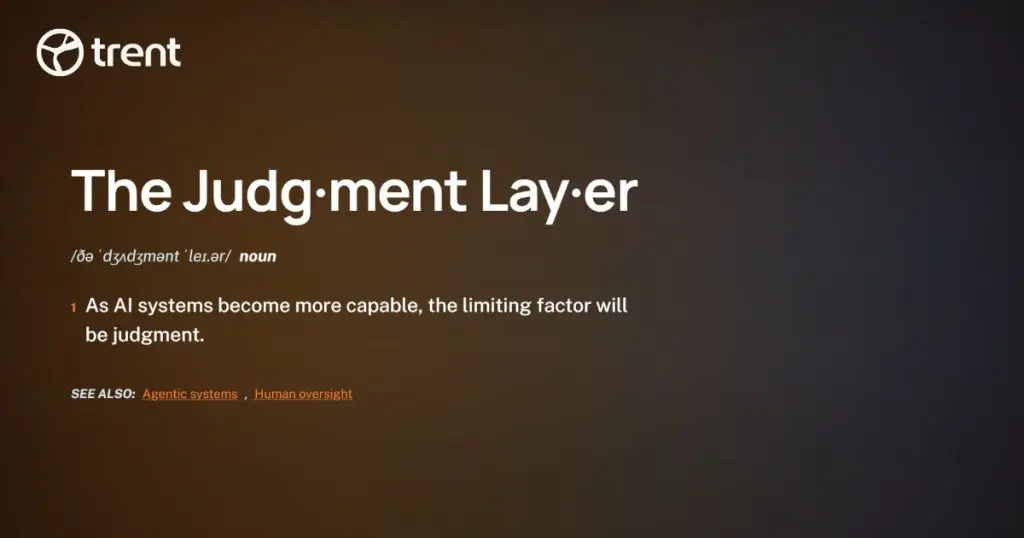
As AI systems become more capable, the limiting factor will not be computation. It will be judgment. The organizations that succeed will not be those that remove humans from the loop. They will be the ones that preserve human authority while using AI to make better decisions, faster. Real-world AI safety needs to be about more than just alignment. It needs to be about ensuring that, in increasingly autonomous systems, judgment remains exactly where it belongs.