What Is Agentic AI Security?


AI systems no longer just generate text; they take autonomous actions. Modern AI agents can call APIs, write to databases, execute code, spawn sub-agents, and operate continuously without direct human supervision. This shift demands a new discipline: Agentic AI Security.
Traditional security, perimeter defenses, static code analysis, human-operated controls, assume software that people write and run. It doesn’t account for systems that reason, decide, and act on their own. As you deploy agentic AI into production workflows, security must evolve from guarding inputs and outputs to controlling what autonomous systems can actually do. As Neil Lawrence, Co-Founder and Chief Scientist at Trent AI, explores in “Agents, Checklists, and the New Architecture of Intelligence”, these agent systems are reshaping how we think about software boundaries.
Today, let’s define agentic AI security, examine the emerging threat landscape, apply the STRIDE threat-modeling framework to autonomous systems, and outline the controls required to build secure agentic architectures, grounded in OWASP guidance and real-world attack scenarios.
What Is Agentic AI?
Agentic AI refers to AI systems that autonomously plan, decide, and execute multi-step actions to achieve goals, not just respond to queries.
Unlike conversational AI, agentic systems interact directly with external resources: APIs, databases, file systems, CI/CD pipelines, and other services. They can decompose tasks, select tools, chain actions, and determine their own next steps. Common examples include LangChain agents, AutoGPT, CrewAI, BabyAGI, Claude Code, Microsoft AutoGen, and enterprise multi-agent frameworks. Platform capabilities such as OpenAI function calling, Anthropic’s Model Context Protocol (MCP), and Google’s Gemini agents enable models to act as operational components rather than passive interfaces.
You’re probably already seeing this in practice. Agentic AI showing up in customer service, code generation, data analysis, security operations, and supply chain management. Each deployment puts an autonomous system in direct contact with production data and infrastructure. When models can act, not just respond; failures have operational consequences. Security must shift from prompt hygiene to operational containment.
Why Agentic AI Creates New Security Risks
With a chat-only LLM (Large Language Model), a prompt injection might produce misleading text. With an agentic system, that same injection can delete production data, exfiltrate customer records, or push malicious code to your repository. The attack surface expands from a single model endpoint to every tool, API, and system the agent can reach. The question of whether you can trust AI to secure your code gets more urgent when AI systems act autonomously.
Eight risk categories define this threat landscape, all mapped to OWASP LLM vulnerabilities. Prompt injection (LLM01) hits hardest because agents can act on injected instructions, not just repeat them. Over-permissioned agents compound every other risk (LLM06): give an agent unrestricted tool access, and a single redirected instruction becomes a destructive action. Without execution checkpoints, agents chain reasoning indefinitely (LLM10), deciding their own next steps with nothing between them and your infrastructure. Meanwhile, insecure file writes, shell access, and web requests open attack surfaces that don’t exist in chat-only systems.
Goal manipulation (LLM04) is subtler. Attackers poison the prompt, the retrieved context, or the system instructions, and the agent follows the new directives as if they were legitimate. In multi-agent pipelines, one compromised agent can spawn sub-agents or corrupt the shared context that downstream agents rely on, cascading a breach through the entire workflow.
Supply chain compromise (LLM03) starts before you write any code: malicious plugins, MCP servers, or third-party components introduce vulnerabilities at the dependency level. And agents acting on hallucinated information (LLM09), deleting files for nonexistent threats, sending data to fabricated endpoints, cause real damage from data that never existed.
Agentic AI Security Defined
Agentic AI Security is the discipline of designing, monitoring, and constraining autonomous AI systems to prevent malicious, unintended, or unsafe actions. It extends traditional LLM security by addressing agents that autonomously interact with APIs, databases, file systems, and external services; systems that can act, not just respond. A useful analogy is sandboxing untrusted code execution, except the “code” here is a reasoning system that plans, adapts, and self-directs.
Below are five foundational principles that extend OWASP LLM06 (Excessive Agency) and LLM10 (Unbounded Consumption) from the model level to the system level, aligning closely with the NIST Cybersecurity Framework‘s Identify, Protect, Detect, Respond, and Recover functions.
Five Foundational Principles
- Containment
Constrain action scope using sandboxing, API allowlists, and resource limits. - Observation
Maintain continuous telemetry, decision traceability, and human-in-the-loop checkpoints. - Accountability
Log all agent actions, decisions, and reasoning chains with immutable audit trails. - Isolation
Separate model execution, tool access, and data layers to prevent cross-session leakage. - Governance
Define acceptable actions, override logic, and escalation paths before deployment.
I’m happy to report that we built Trent AI’s Agentic Threat Assessor to put these principles into practice. It continuously analyzes your architecture and flags threats before they show up in production.
Benchmark Your AI Security Maturity
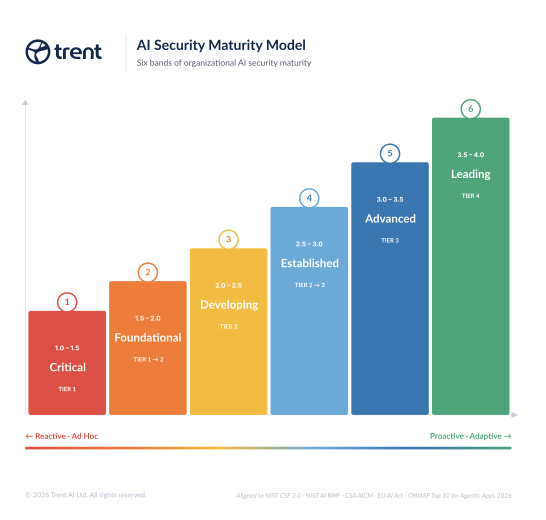
The ASMM scores your security program’s maturity across six NIST CSF domains so you know exactly where it stands.
STRIDE for Agentic Systems
STRIDE (Spoofing, Tampering, Repudiation, Information Disclosure, Denial of Service, Elevation of Privilege) was originally developed by Microsoft for traditional software threat modeling. Applying it to agentic AI systems is a novel but powerful extension.
Most threat modeling frameworks assume request-response architectures: a user sends a request; the system processes it and returns a result. Agentic systems break this model. An agent might receive a prompt, reason about it, call three different APIs, modify a database, and trigger another agent, all in a single execution chain. Each step crosses a trust boundary.
STRIDE is particularly valuable here because it forces you to think about each boundary explicitly. A single agent action can cross trust boundaries that traditional applications never touch in a single request. You need to model not just software components but also agent-to-agent trust, shared context integrity, and the problem of multi-step reasoning where each step can alter the next.
| STRIDE Category | Agentic AI Manifestation | Example |
|---|---|---|
| Spoofing | Impersonating legitimate agents or users | Malicious agent masquerades as an authorized service agent |
| Tampering | Modifying prompts, tools, or memory | Attacker alters tool schema to change behavior |
| Repudiation | Missing audit trails | Agent deletes data with no attributable decision log |
| Information Disclosure | Context or credential leakage | Agent leaks PII across user sessions |
| Denial of Service | Recursive agent calls | Agent exhausts API quotas through loops |
| Elevation of Privilege | Unauthorized access escalation | Agent escalates from read-only to write access |
Critical Security Controls
Here are seven controls that cover the essentials, mapped across OWASP LLM01, LLM02, LLM05, LLM06, LLM07, and LLM10. You need all of them working together:
- Sanitize all prompts, tool outputs, and retrieved data before agent processing. Defend against both direct injection (where a user attacks the model) and indirect injection (where malicious content in retrieved data redirects the agent). That’s input validation, your first line of defense (LLM01).
- Restrict your agents to the minimum necessary tools and data. Scoped API keys and role-based access, not broad credentials. If an agent only needs to read from a database, don’t give it write access (LLM06).
- Sandbox agent execution so a compromised agent can’t reach the filesystem, network, or OS beyond its container (LLM06).
- Set token budgets, call limits, and circuit breakers, so a misbehaving agent burns through its allocation and stops, not your infrastructure (LLM10).
- Log every agent decision and tool invocation with immutable, tamper-proof records. You need this for forensics and compliance, and you need a compromised agent to be unable to cover its tracks.
- Require human approval for sensitive actions: data deletion, financial transactions, privilege changes, external communications. Define your approval gates before deployment, not after an incident (LLM06).
- Validate all outputs before they reach tool executors or external systems. Check for forbidden action patterns, data leakage indicators, and malformed invocations. This is your last check between reasoning and real-world consequences (LLM05).
If you’re building agentic workflows and want real-time validation of what’s passing between your users, models, and agents, that’s exactly the problem Trent AI built Prompt Guard to solve.
Read more: For a deeper look at how these controls work at the application layer, see our LLM Guardrails guide.
Architecture of Secure Agentic Systems
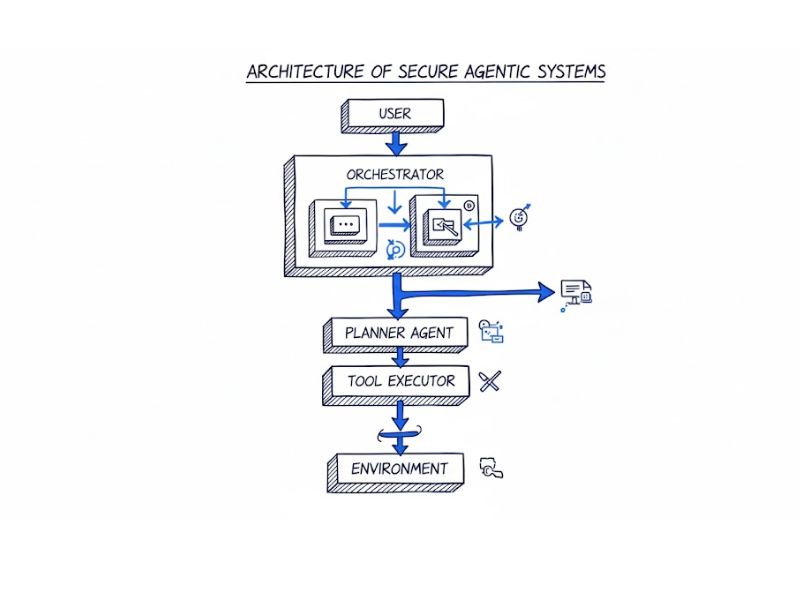
Secure agentic systems follow a layered defense-in-depth architecture:
User → Orchestrator → Planner Agent → Tool Executor → Environment
Security controls must exist at every boundary:
- Input layer: Prompt sanitization and context validation
- Orchestration layer: Agent authorization and task boundaries
- Execution layer: Sandboxed tool execution and output filtering
- Data layer: Session isolation and credential vaulting
For RAG-enabled (Retrieval-Augmented Generation) systems, vector stores and embedding pipelines are additional attack surfaces requiring access controls and ingestion validation (OWASP LLM08). Defense-in-depth is the organizing principle: multiple independent controls so that if one fails, the next catches the problem. Circuit breakers and fail-safes should terminate agent execution when safety thresholds are breached, whether that’s a token limit, time limit, or a forbidden action pattern. For credential management, use short-lived tokens for agent-to-service authentication, rotate them automatically, and never embed API keys in agent configurations or prompts.
Real-World Attack Scenarios
Agentic AI risks are not theoretical. The following scenarios illustrate how real attacks emerge when autonomous agents interact with tools, data, and other agents. Each example breaks down the attack vector, business impact, and the specific security controls required to prevent or contain the failure in production systems.
1. Customer Service Agent PII Leak
A customer submits a support ticket containing a carefully crafted prompt injection hidden inside what looks like a normal complaint. The support agent processes the ticket, and the injected instructions cause it to query another customer’s account and include their personal information in the response.
Impact: Cross-customer PII exposure
Defenses: Input sanitization, context isolation, output PII detection
OWASP: LLM01, LLM02
2. Code Generation Backdoor
A code generation agent pulls context from a repository that’s been subtly poisoned. The agent produces code that passes linting and tests but contains a hardcoded credential, a bypassed authentication check, or a dependency on a malicious package. The backdoor ships to production inside otherwise legitimate code, and no human reviewed the specific lines that matter.
Impact: Backdoored production code
Defenses: Output validation, code review gates, supply-chain verification
OWASP: LLM03, LLM05
3. Data Analysis Exfiltration
A data analysis agent with database access encounters crafted content inside the database itself. The content contains instructions that look like data but manipulate the agent into transmitting proprietary information to an attacker-controlled endpoint through an API the agent has access to. By the time anyone notices, competitive data has already left the network.
Impact: Proprietary data exfiltration
Defenses: Network isolation, egress filtering, tool allowlisting
OWASP: LLM01, LLM06
4. Multi-Agent Chain Poisoning
In a multi-agent pipeline, one compromised agent modifies the shared context that downstream agents rely on. The poisoned context causes the next agent in the chain to escalate privileges, access data it shouldn’t have, or take actions outside its intended scope. The attack propagates through the chain because each agent trusts the context it receives.
Impact: Privilege escalation across agents
Defenses: Context integrity checks, inter-agent trust verification
OWASP: LLM04, LLM06
Compliance and Governance
Right now, you probably already have compliance obligations that apply to your agentic AI deployments. The frameworks exist; you just need to interpret them for autonomous agents. You also need to extend your incident response plans to cover agent-caused breaches: the ability to immediately revoke agent permissions, halt execution across all active agents, and preserve the decision logs that explain what happened.
- SOC 2: Agent actions are processing activities under CC6 and CC7. Every tool invocation requires logging and access control.
- GDPR: Data minimization and purpose limitation apply directly to agent workflows.
- EU AI Act: Some agentic systems may fall under higher-risk categories depending on domain; GPAI obligations apply broadly.
- NIST AI RMF 1.0: Provides lifecycle governance from design through monitoring.
A structured way to gauge where your program stands is the AI Security Maturity Model, which scores AI security maturity across six NIST CSF 2.0 domains.
The Future: Emerging Challenges
Agentic AI security is still an emerging discipline. As autonomous systems grow more capable, new threat classes are already appearing that existing security frameworks do not fully address. Four challenges are already visible, grounded in current system architectures, not speculation, that security leaders and builders must prepare for now.
- Inter-agent trust: Agents must verify the integrity and authorization of other agents.
- Self-modifying agents: Systems that alter their own prompts or tools introduce new security boundaries.
- Adversarial agent ecosystems: Open agent marketplaces require attestation and verification.
- Regulatory evolution: Governance for autonomous systems is accelerating globally.
Tomorrow’s firewalls won’t block packets — they’ll block actions.
Conclusion
Agentic AI dramatically expands what software can do, and what can go wrong. As AI systems become agents, the security perimeter shifts from code to conduct. The discipline of Agentic AI Security provides the frameworks, controls, and governance required to build autonomous systems that are secure by design.
Before your next security review, ask your team:
- Does our threat model cover AI-specific attack vectors like prompt injection and tool exploitation?
- Are our agents running with least-privilege permissions, or do they have broader access than they need?
- Do we have circuit breakers that stop runaway agent execution?
- Can we audit every decision and tool invocation our agents make?
- Who reviews agent outputs before they reach production systems?
I invite you to explore Trent AI’s platform that delivers context-driven security through specialized agentic AI technology, embedding expert-level protection directly into developer workflows.
Reviewed by Eno Thereska, Co-founder & CEO at Trent AI
Frequently Asked Questions
What is agentic AI security?
Agentic AI security is the discipline of designing, monitoring, and controlling autonomous AI systems to prevent malicious, unintended, or unsafe actions. It extends traditional LLM security (prompt injection defense, output filtering) to cover the full lifecycle of autonomous agents that interact with APIs, databases, file systems, and external services.
What are the biggest risks of agentic AI?
The eight primary risks are: (1) compounded prompt injection leading to real-world consequences, (2) excessive agency from over-permissioned tools, (3) unbounded autonomy without checkpoints, (4) tool and API exploitation, (5) goal manipulation via context poisoning, (6) autonomous propagation of compromised agents, (7) supply chain compromise through malicious plugins and MCP servers, and (8) agents acting on hallucinated information.
The vocabulary here is still settling. We define these and eighty other terms in our agentic AI security glossary.
How do you apply STRIDE threat modeling to AI agents?
STRIDE maps to agentic AI as follows: Spoofing (agent impersonation), Tampering (modifying agent instructions or memory), Repudiation (lack of agent audit trails), Information Disclosure (cross-session data leakage), Denial of Service (recursive agent call exhaustion), and Elevation of Privilege (agents accessing unauthorized tools or data).
What security controls do AI agents need?
AI agents require seven essential security controls: input validation against prompt injection, least privilege for tool access, sandboxed execution environments, rate limiting with circuit breakers, comprehensive audit logging, human-in-the-loop approval for sensitive operations, and output validation before tool execution.
Does SOC 2 apply to AI agents?
Yes. Under SOC 2’s Trust Services Criteria (CC6 Logical Access, CC7 System Operations), autonomous AI agent actions should be treated as processing activities. This extends audit logging and access control requirements to every tool invocation, API call, and data access performed by an agent.