
AI Security Engineer: The Continuous Security Agent for Agentic Systems


What Is an AI Security Engineer?
An AI security engineer is software built for agentic systems: it maps your architecture, inventories every agent and tool, traces how they could be chained into an attack, and recommends fixes for what’s genuinely exploitable. In other words, the always-on version of work a security engineer used to do alone.
It runs continuously rather than on a schedule, because the systems it assesses change without a release. When you wire a new tool into an agent, connect to a new MCP server, edit a prompt, and then architecture is no longer the one your last review described.
But, these same three words are also a job title, and that is where most people meet them first.
Is an AI Security Engineer a Person or Software?
A short answer is both. Security teams use “AI security engineer” to describe a job posting, and a growing number of security vendors use it to describe a product, and as of 2026 neither usage has won.
Human software reading is real, and on volume it is winning. The job title sits on open roles at large companies, and certification programs now exist that formalize it as a credential, which means it will keep being minted as a human job for years. Read the responsibilities under those job postings rather than the title, and most of them describe a conventional security engineer role with AI added to the name. That is not a knock on the people in those roles; it is a description of how job titles get written.
The software reading is not a Trent AI original either. Several AI security vendors now attach the phrase to a product, and several use near-identical wording for it. The phrase on its own no longer differentiates anything, so anyone who tells you an AI security engineer is software is reporting a convention, not making an argument.
Here is the argument. The bolt-on is the problem. Agents are already writing and shipping code faster than any single person with a title can read it, and there were already 80 developers to every security engineer before the agents joined the developers. Putting “AI” in front of a human’s job title does not close this gap. It names it.
What is genuinely unclaimed is the qualifier. An AI security engineer for agentic systems, as distinct from one for data exposure, for pre-production code scanning, or for observability, is a different scope, and it is the scope that matches where the risk actually moved.
What an AI Security Engineer Must Do for Agentic Systems
Five capabilities separate an AI security engineer built for agentic systems from one repurposed for them: a capability inventory, attack-chain tracing, exploitability judgment, verification of the controls that should stop an attack, and continuous re-assessment. Together they are what agentic AI security demands at the application layer, and each one is a requirement a conventional AI application security tool cannot meet against your agents without being rebuilt.
- Capability inventory. Every agent, tool, skill, and MCP server in the environment, classified by what it can actually do: Read, Write, Execute, Egress. A component’s name and its documentation are not evidence of what it can reach. Its permissions are. This is OWASP LLM06, Excessive Agency, treated as an inventory problem rather than a policy one, and the test is whether the system enumerates the estate or only the parts a human already knew to point it at.
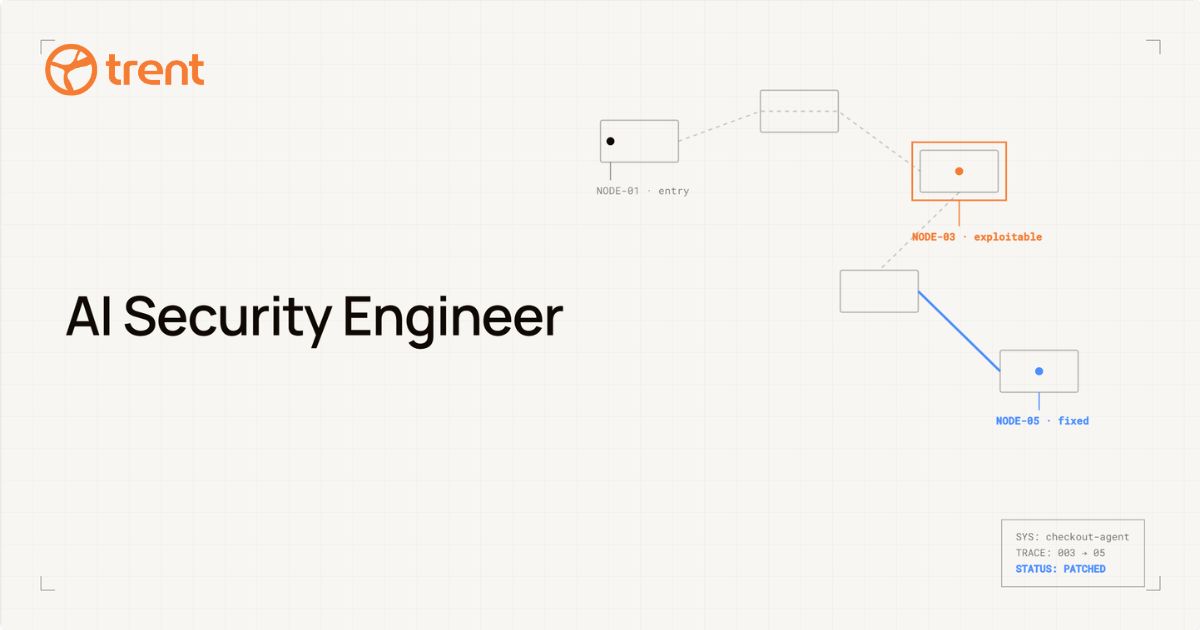
- Attack-chain tracing. The unit of analysis is the path, not the finding. Untrusted input enters through a Read capability, flows into an agent’s context, and reaches something that can Write, Execute, or Egress with no gate in between. MITRE ATLAS and the OWASP Agentic Security Initiative Top 10 give those links names, and Simon Willison’s lethal trifecta names the combination that makes them dangerous together: read untrusted data, run code, exfiltrate. If you want these terms in full, the glossary has them.
- Exploitability judgment. Whether a weakness is reachable in your system’s real wiring, with these permissions and these trust boundaries, not whether a pattern matched a CWE class somewhere in the repository. A severity score inherited from an underlying scanner is not judgment. The question an engineer answers is which untrusted input reaches this weakness, through which capabilities, and what happens when it does.
- Verified controls, not assumed ones. A sandbox that engages only after the decision doesn’t stop the chain from starting; it limits where it ends. The requirement is to confirm that a named authorization gate, sandbox boundary, or audit log sits before the point of consequence and is structurally capable of stopping the specific chain, rather than reporting it as present in the architecture. What that looks like applied to a real agent framework is its own piece of work. The criterion here is only that the check happens.
- Continuous reverification. Agentic systems do not hold still between releases. A new tool, an upgraded model, a changed prompt, and the effective behavior is different with no commit to review. Secure AI development under those conditions means the assessment reruns when the system changes and reports regression, not only new findings. NIST’s AI risk framework treats risk management as a lifecycle function for the same reason: a result from the last sprint describes an architecture that may not exist anymore.
| Criterion | What it rules out | Framework anchor |
| Capability inventory (Read/Write/Execute/Egress) | Reporting only on agents someone already knew to point it at | OWASP LLM06 |
| Attack-chain tracing | Flagging isolated findings with no path between them | MITRE ATLAS, OWASP Agentic Security Initiative |
| Exploitability judgment | Inheriting a generic severity score from an underlying scanner | CWE, reachability analysis |
| Verified controls | Assuming a listed sandbox or gate actually stops this chain | OWASP LLM06, SOC 2 CC6/CC7 |
| Continuous re-verification | A scan result describing an architecture that no longer exists | NIST AI RMF lifecycle |
Use these five as a checklist. Point them at whatever is already running in your stack and ask which ones it actually meets, not which ones its marketing implies.
How to Evaluate an AI Security Engineer Alongside SAST, DAST and SCA
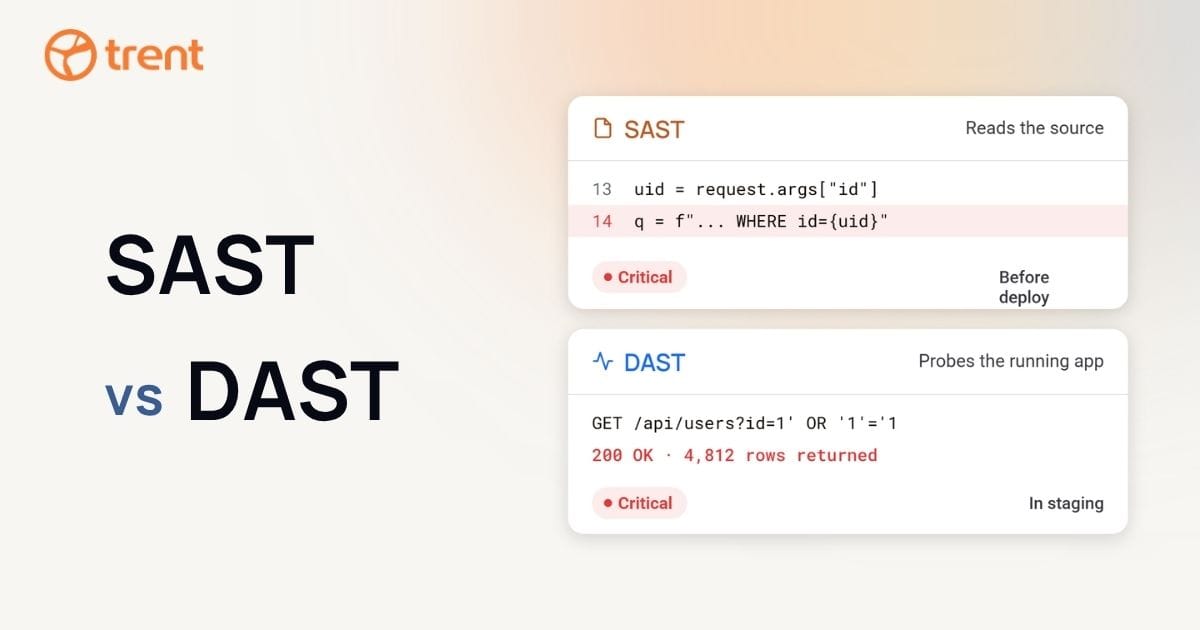
SAST, DAST, and software composition analysis are not obsolete, and an AI security engineer does not replace them. It answers a question none of the three were built to ask: what will this system do when the risk is a decision the agent makes at runtime, rather than a static defect sitting in the code.
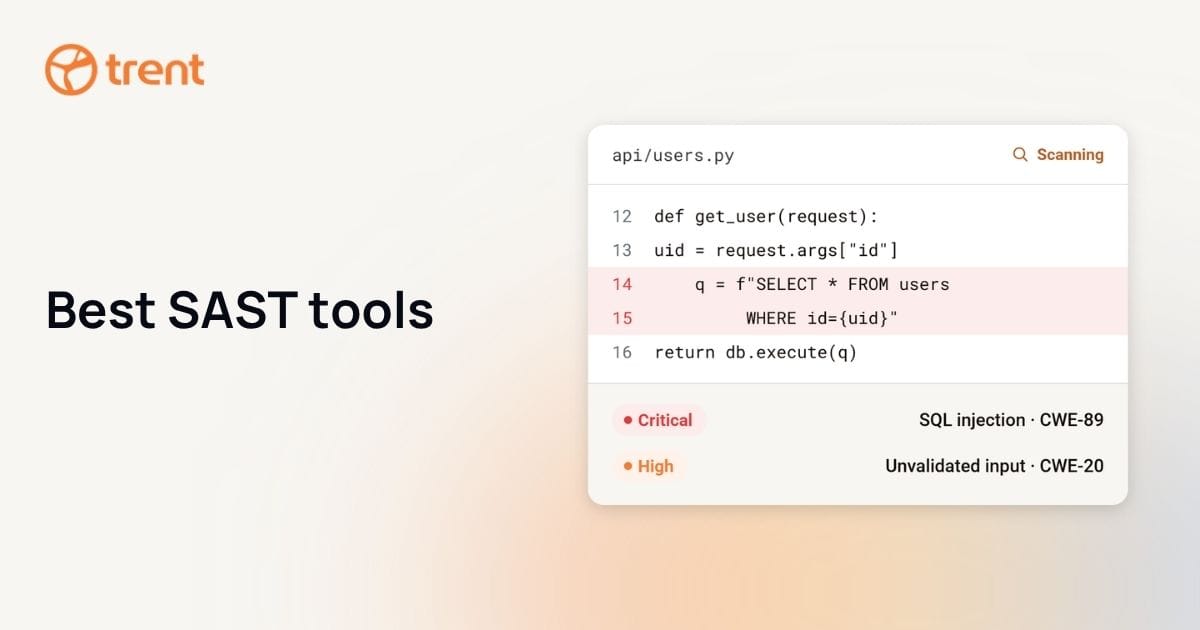
SAST reads source for known-bad patterns. DAST probes a running application from the outside for known vulnerability classes. SCA matches dependencies against known CVEs. Each does its job, and each job is real.
What none of them can represent is an agent’s runtime decision as a risk variable, because none of them was built for software that chooses its next action from natural-language input it just read. A tool description is not a code path. A poisoned document is not a dependency. The AI security tools most teams already run are looking for defects in an artifact that holds still, and the artifact stopped holding still.
So, this is a scope claim, not a replacement claim. Keep the scanners. They still catch the hardcoded secret and the abandoned package, and an AI application security program without them has a hole in it. They just cannot see the thing that makes an agent an agent.
This is the scope Trent is built for
Trent runs this scope continuously against your real code: it inventories every agent, tool, and MCP server, traces the attack chains between them, and judges what is genuinely exploitable in your specific environment.
What It Doesn’t Do: The Human-in-the-Loop Line
An AI security engineer reads source and configuration. It does not watch an agent run in production. It does not exploit anything, and it does not make the call on what to fix first. A person still makes that call.
The analysis is grounded in code, not in live exploitation or penetration testing. Its value is in catching the missing control, the authorization gate, the sandbox, the audit log, before the agent ever runs. That is a narrower claim than “it attacks your system to prove the risk,” and it is the true one.
Trent recommends; your team decides. That is a design choice, not a limitation waiting to be engineered away. It is also the only precise sense in which any of this is autonomous: the software runs continuously without waiting for someone to trigger it. It never changes your code itself, and it does not replace a hire. The engineers who have watched a scanner confidently rank a non-issue as critical are right to want the final say, and the final say stays with them.
You stay in the loop. The software does the part you cannot: reading every path through your system, every time the system changes.
AI Security Engineer vs AI SOC Analyst vs AI Pentesting Tool
A final note on a couple of terms. All three are software, named after a human security role, and the split is by task. An AI SOC analyst triages live alerts in a security operations center. An AI pentester probes a running system. An AI security engineer works upstream, on the architecture and the source itself, finding the missing controls before either of the other two would ever see a signal.
An AI security engineer reads source and configuration. It does not watch an agent run in production, and it does not exploit anything. The analysis is grounded in code, not in live exploitation or penetration testing. Its value is in catching the missing control, the authorization gate, the sandbox, the audit log, before the agent ever runs.
| Product type | Works on | When it sees the problem |
|---|---|---|
| AI security engineer | Architecture, source and configuration | Before the agent runs |
| AI SOC analyst | Live alerts in a security operations center | After something fires |
| AI pentesting tool | A running system | When it probes |
Reviewed by Zack Rossman Head of Engineering at Trent AI
Put an AI security engineer on your agents
Connect your repository and agent definitions. Trent maps every agent, tool, and permission, grades what is exploitable, and re-assesses as you ship.
What is an AI security engineer?
An AI security engineer is a software system that continuously does a security engineer’s core work on an agentic system: reconstructing the architecture from the real code, inventorying every agent, tool, and permission, tracing how an attacker could chain them, judging what is genuinely exploitable, and confirming a fix held. The same phrase is also used, widely, for a human engineer’s title.
Is an AI security engineer a person or software?
Both uses are in active circulation, and the term is genuinely contested. Job boards, recruiters, and certification programs use “AI security engineer” for a human role. A growing number of security vendors, Trent among them, use the same phrase for software that performs that role’s core tasks continuously. Neither usage is wrong. Ask which one the source means.
How is an AI security engineer different from a code scanner?
A scanner returns findings against known rules: a hardcoded secret, an outdated dependency, a matched CVE pattern. An AI security engineer returns judgment. It reconstructs how the system is actually wired, traces multi-step attack chains a scanner cannot see, decides what is exploitable in that context, and verifies that a fix closed the path.
What makes an AI security engineer for agentic systems different from general AI security tools?
General AI security tools scan for known issues in AI and ML pipelines: model weights, training data, prompt filters. “For agentic systems” means the software reasons about what an agent can decide to do at runtime. Which agents read untrusted input, which can execute code or reach the network, and how those capabilities chain into an attack no static scanner would flag.
What does an AI security engineer actually do?
It inventories every agent, tool, and permission in a system; maps how they connect; traces the paths an attacker could chain; grades exploitability against the real deployment rather than a generic severity score; proposes or generates a fix; and re-checks on the next pass to confirm the path is closed and has not regressed. It runs as a loop, not a report.
Do you still need a human security team if you have an AI security engineer?
Yes. An AI security engineer is built to be corrected, not trusted blindly. A person reviews recommendations before anything is applied, and nothing changes on its own. The honest framing is augmentation: it gives a small or nonexistent security team the coverage of a senior specialist and gives an existing team back the hours they lose to triage.
How is an AI security engineer different from an AI SOC analyst or an AI pentester?
All three are software named after a human security role, and the split is by task, not seniority. An AI SOC analyst triages live alerts in a security operations center. An AI pentester probes a running system. An AI security engineer works upstream, on the architecture and the source itself, finding the missing controls before either of the other two would ever see a signal.