
Introducing Your AI Security Engineer: Modernize Security Across Your Systems & Agents

Every company is shipping more code and more agents than it can hire security experts to cover. That gap is quickly becoming the defining security challenge of our industry, and it’s why we’re building the AI-native security engineer.
We’ve been building software for years, and security has always been one of the hardest parts. Not because security tools are lacking; there are plenty of those. It’s because practical security expertise is scarce, and the engineers, who can look at a system and tell you what’s actually exploitable, and what to do about it, are expensive, hard to hire, and stretched far too thin.
At the same time, major shifts are happening. There’s more software to secure than ever, and a fast-growing share of it is agent-driven. AI agents and LLMs are nondeterministic by nature. They hallucinate, resist conventional testing, and operate on probabilities rather than guarantees, which is exactly what breaks both a security engineer’s mental models and most existing org policies.
Securing software that doesn’t behave the same way twice, takes a fundamentally different kind of expertise. We believe it takes an AI-native approach to secure AI-native software, and the same models that help defenders, are now in attackers’ hands. The expertise gap that was already the hardest part of building secure software is widening from every direction.
This is the gap, we built Trent to close.
Meet Trent, Your New AI Security Engineer
Today we’re introducing Trent: your AI Security Engineer. Think of Trent as an experienced security engineer embedded in your team. Someone you can talk to like an engineer at your side.
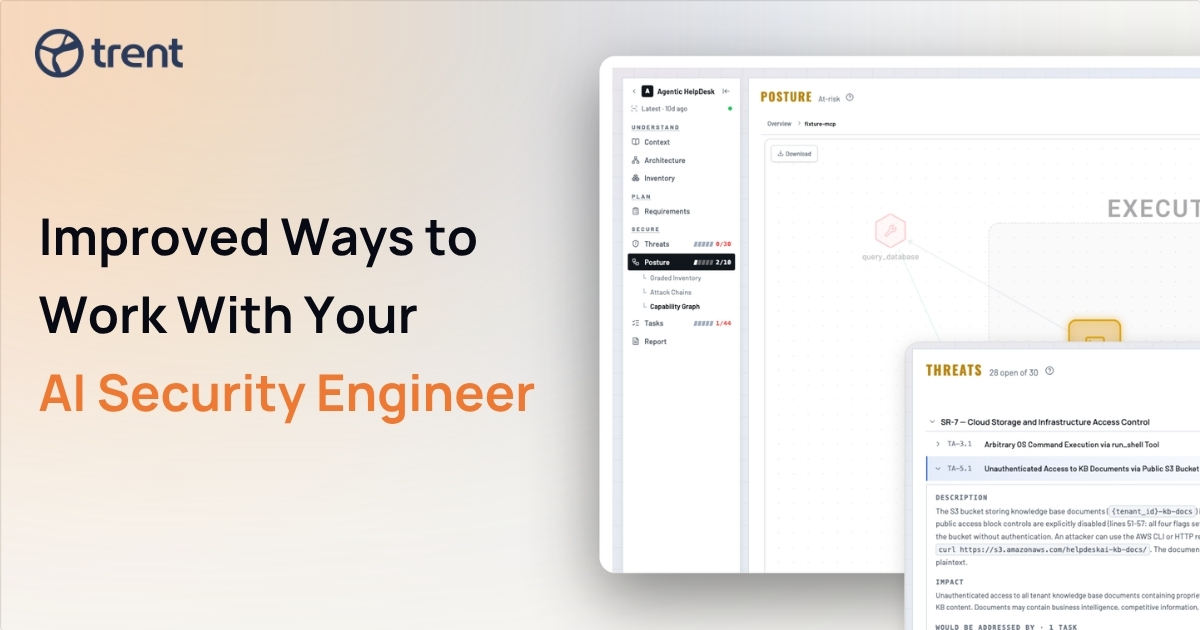
This new addition to your team, starts by mapping what you’re actually running, and how it fits together: your application code, infrastructure code, configurations, agents, and automations, along with the data and trust flows between them. What you get back isn’t a black box. It’s concrete, inspectable work: an inventory graph, architecture and data-flow diagrams, a threat model, and a prioritized findings list, with all the reasoning behind each one.
From there, Trent, your AI Security Engineer, finds what’s genuinely exploitable, with context-aware fixes, and it can map the compliance frameworks you answer to, like SOC 2 and NIST, onto the controls and tools you actually run, surfacing the gaps. Crucially, it works across your entire stack, including the AI agents and automations that traditional security tools were never designed for.
The goal isn’t to replace your security team. It’s the opposite. Instead, Trent gives every engineering organization access to the kind of deep security expertise that’s increasingly expensive, difficult to hire, and stretched too thin. For AI-native startups, Trent is the first security engineer you don’t have to hire. For enterprise teams, Trent augments the people you already have, keeping them current as the stack evolves and cuts the toil that buries them.
Where Trent Adds Value
The value shows up in the moments where you’d normally wish a senior security engineer were available to weigh in.
Answers, not another layer of alerts
Over 80% of security alerts are false positives, burning hours that should go to real risks. Trent ingests and correlates your code, infrastructure-as-code, cloud configuration, and agent definitions into one picture, then surfaces the risks that actually matter for your business. For example, a finding that looks critical in isolation is often harmless once you can see the architecture around it. So, the more context Trent has, the fewer false positives you chase. You get a short, prioritized list with the reasoning behind it, instead of hundreds of disconnected alerts.
A judgment layer on top of the tools you already run
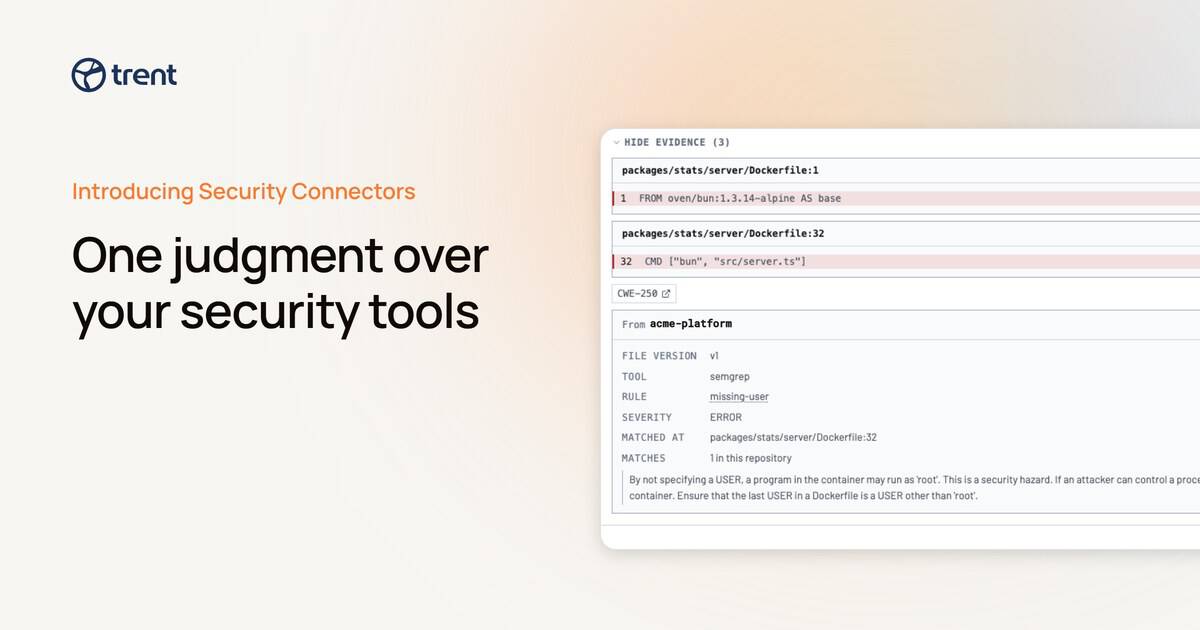
The average team now runs 76 disconnected security tools, none of them aware of the others. Trent isn’t a 77th. It sits above the ones you already own, normalizing their output, judging each finding for real impact, and collapsing the noise into a single prioritized plan. For example, when two of your scanners disagree on a finding, Trent is the reconciliation point: it de-duplicates the overlap and recalibrates severity against your real architecture. So, your team works from one source of truth instead of three conflicting lists. And because you can talk to Trent like an engineer, your principal security engineer’s explicit requirements (“PII has to stay in the EU,” “this service is internet-facing”) flow straight into the analysis and sharpen the results.
Close the loop, don’t open a ticket
Finding a risk is the easy part, and most tools stop there and hand you a list. Trent goes further. When it identifies a real risk, it generates the fix: a ready-to-run prompt for the coding assistant you already use, like Claude Code or OpenClaw. Once your team applies the fix, Trent confirms the fix actually landed, and flags it again the moment a later change regresses it. Detection, handoff, verification, and regression tracking in one loop, with a full audit trail at every step. And, Trent does this for the 20+ new AI attack classes introduced in the last two years (prompt injection, tool misuse, memory poisoning, and more) that traditional scanners were never built to catch, not just for the classic code bugs.
None of these mentioned above are surface-level findings a static scan would catch. They live in your architecture, in how your system actually behaves, and that’s exactly where Trent, your AI Security Engineer works.
A Day in the Life, With Trent at Your Side
The best way to understand what it’s like working with Trent, is to hear it from someone who does the work. Here is a principal security engineer, in his own words, describe their recent work day, running a security assessment for a tech company client, with AI Security Engineer Trent at their side:
9:00am. Another day, another customer. I’m at their offices, the CTO grants me access to their codebases, and we have a quick chat about what keeps them up at night. I drop their GitHub repos into Trent while I start reading their design docs.
9:25am. I tell Trent what I learned from the CTO, and set the security goals for this assessment. They sell a multi-tenant platform, so cross-tenant leakage is the thing they can’t afford to get wrong. Good to know. Trent keeps that as context for everything it does next.
10:00am. Trent’s first analysis is back. I read the executive summary first and check that it matches my read on the business and the product. It does. I scan the findings and there’s a critical one for stored credentials, so I ping the dev team right away so they can start on it. The threat model has flagged a couple of components that are massively multi-tenant and lean on long-lived credentials, exactly the risk the CTO mentioned. I make a note to dig in there.
10:35am. The reports start coming in: my legacy scanners, some output from Claude and Codex, and then the CTO remembers he has two old pentest reports sitting in his inbox. I throw all of it into Trent’s security context. It de-duplicates the overlap and recalibrates severity across sources. So instead of drowning in the same finding five times, I can actually verify things and hunt for similar bugs.
10:45am. Enough looking at tools. I dig into that multi-tenant component by hand, the kind of crypto-heavy code where I know there’s something to find if I look properly. This is the part I love, and it’s the part Trent cleared the runway for me.
2:00pm. Reviewing the findings, I notice Trent has over-rated a couple as critical, that are really mediums at most, given how the service is deployed. I knock them down and tell Trent to recalibrate. It doesn’t argue, it adjusts, and it stops flagging that pattern as critical for the rest of the assessment. I’d never let a tool set severities for me unchallenged, and I don’t have to.
3:35pm. Trent’s incremental analysis notices the dev team already shipped a fix for this morning’s credentials bug, verifies it, and marks it mitigated. But, it also catches that two bugs from last month’s pentest report have regressed, because of recent code changes. That’s the kind of thing that quietly slips through and burns you later.
4:00pm. I ask Trent for the full assessment report and tweak the wording to match what the team cares about; then check the appendices have the coverage matrices for their compliance needs. By 4:30 it’s with the CTO and his team, and I’ve granted them access to Trent and the project. Another assessment done. Honestly, last year this would have taken me a week or two to cover just half of this work.
How the AI Security Engineer Works
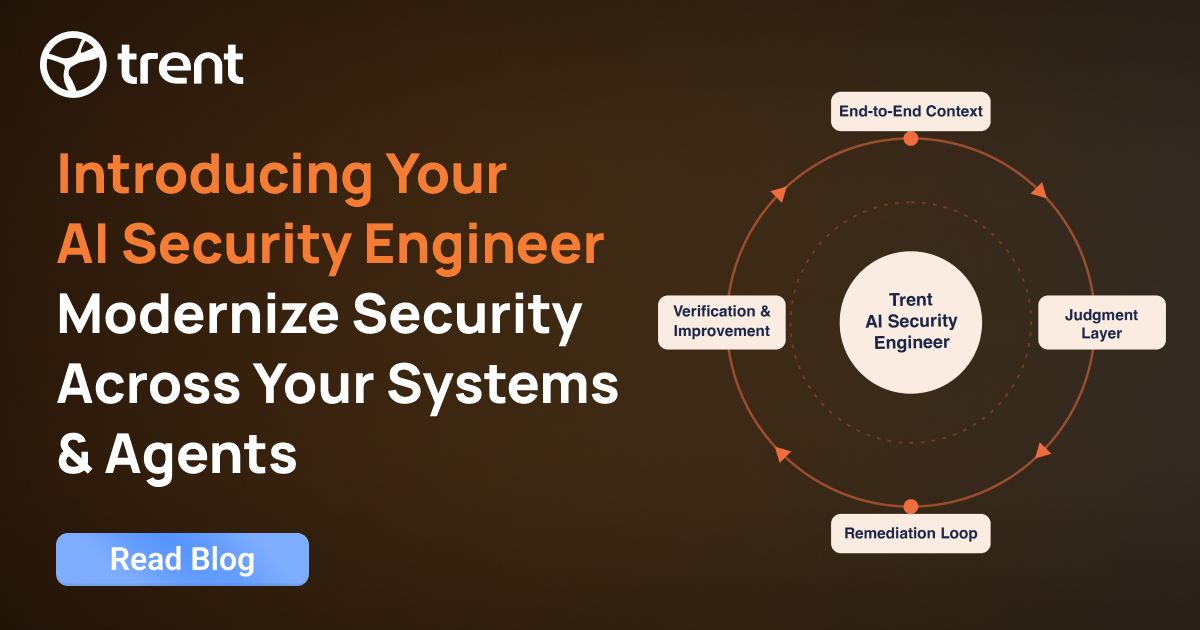
Under the hood, Trent runs as a loop of specialized security agents, not a one-time scan.

End-to-End Context
Trent reads your code, docs, and security reports, in any language and any stack, into one continuously updated context layer.
Judgment Layer
It reasons over that context, and the tools you already run, to triage and prioritize the threats and vulnerabilities that actually matter, filtering out the noise.
Remediation Loop
It generates a fix recommendation, or a ready-to-run prompt for your coding assistant, and hands it to the development environment of your choice. Trent proposes the fix; your team stays in control of applying it.
Verification & Improvement
It confirms the fix landed, with a full audit trail, then feeds every cycle back so Trent keeps learning and the context stays current.
When Trent Gets Something Wrong
Trent gets things wrong sometimes; the way any analyst does. That’s exactly why it’s built to be corrected, not blindly trusted. A human reviews every recommendation before it’s applied, and nothing touches your code automatically. When Trent over or under-rates a finding, you overrule it, and it recalibrates; so it stops repeating the same mistake on your stack. And because the loop verifies every fix and tracks regressions, a recommendation that didn’t actually work gets caught rather than quietly marked done. The honest version is simple: Trent is a security expert at your side, not an oracle, and the workflow is designed around that.
And you run and manage Trent on your terms: public cloud, your VPC, or on-prem, with frontier, open-source, or private models. Your code and context never leave your boundary.
Trent also meets you and works with you where you build, integrating with the tools you already use: GitHub, Claude Code, Codex, Cursor, OpenClaw, and more via MCP.
See It For Yourself
Your AI Security Engineer shouldn’t be the thing that slows you down, or the expertise you can’t hire fast enough. Trent gives your team the depth of a senior security engineer from day one.