

Skip to content

AI Agent Security

Security Leads: Your AI Agents Can Reach More Than Anyone Agreed To

Know what every agent can reach, and fix the paths an attacker could use.

Ask which agents your company runs, what each can reach and who agreed to that access. Most teams cannot answer all three. AI agent security starts with those answers. Trent, your AI Security Engineer, maps every agent, tool, skill and MCP server from your code, traces how they could be attacked, and fixes it with your coding agents.

Built for security teams stretched thin.

Agentic AI Security Platform Leader, 2026 Cybersecurity Stars Awards

By submitting this form, you request access to Trent AI. We may contact you about your request, access status, and onboarding. You also confirm that you’ve reviewed our Privacy Policy and understand how your personal data will be used.

Securing AI Agents Starts With Questions Nobody Can Answer

An agent reads, decides and acts on its own, often with access nobody ever reviewed as a whole.

  • Nobody Has the Full List

    Agents, tools, skills and MCP servers arrive one pull request at a time. An MCP server is a connector that lets an agent use another system, so each new one is a new way in. Few teams can list them all.

  • Access Nobody Signed Off On

    An agent should get just enough access for its job. In practice it gets an admin key during a demo, or an email tool that can write to anyone. Months later a customer’s security review asks who agreed to that, and nobody can say.

  • The Risk Is in the Combination

    An agent that reads private data, acts on untrusted input and can send data out has what is known as the lethal trifecta. Each piece passes its own review. Put together, one hidden instruction in a ticket or web page can send your data out the door.

AI Agent Security Risks to Map First

What can go wrong when an agent reads, decides and acts on its own. Most of these start in the design and the code, where they can be fixed before launch.

  1. Prompt injection. Hidden instructions in an email, ticket, web page or tool result that the agent follows.
  2. More access than the job needs. Admin keys, shared tokens and MCP servers that open more systems than the agent uses.
  3. Tool misuse. A tool used in a way nobody planned, such as an email tool that can write to anyone.
  4. Data sent out. Private data leaving through any tool that can send messages, files or requests outside.
  5. Poisoned memory or context. Bad records in an agent’s memory or knowledge base that change what it does later.
  6. One agent’s mistake spreading. When agents hand work to each other, one tricked agent can pass the problem down the line.

AI Agent Security, With and Without Trent

Leadership, auditors and customers ask the same questions about your agents. Here is where the answers come from.

Without Trent

  • A hand-made list of agents, missing the newest ones
  • Guesses about what each one can reach, often admin access
  • Each piece passes its own review, and the risky combination goes unseen
  • Approvals buried in a chat thread nobody can find
  • Fixes wait for a security engineer you do not have

With Trent

  • Every agent, tool, skill and MCP server listed from your code, including ones nobody listed
  • A map of what each can read, write, execute or send out
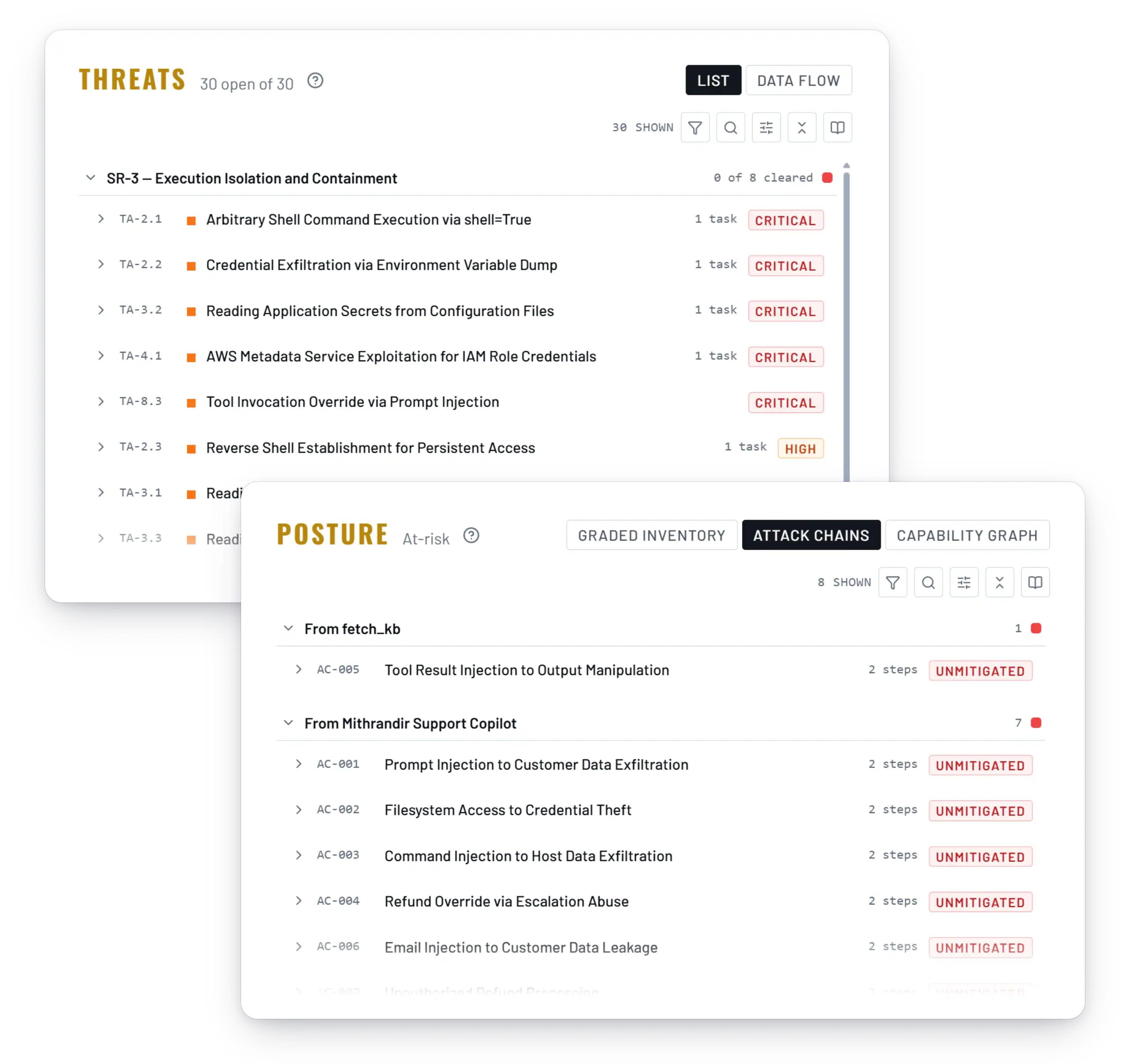
  • Attack chains traced across agents, tools and services, including prompt injection and tool misuse
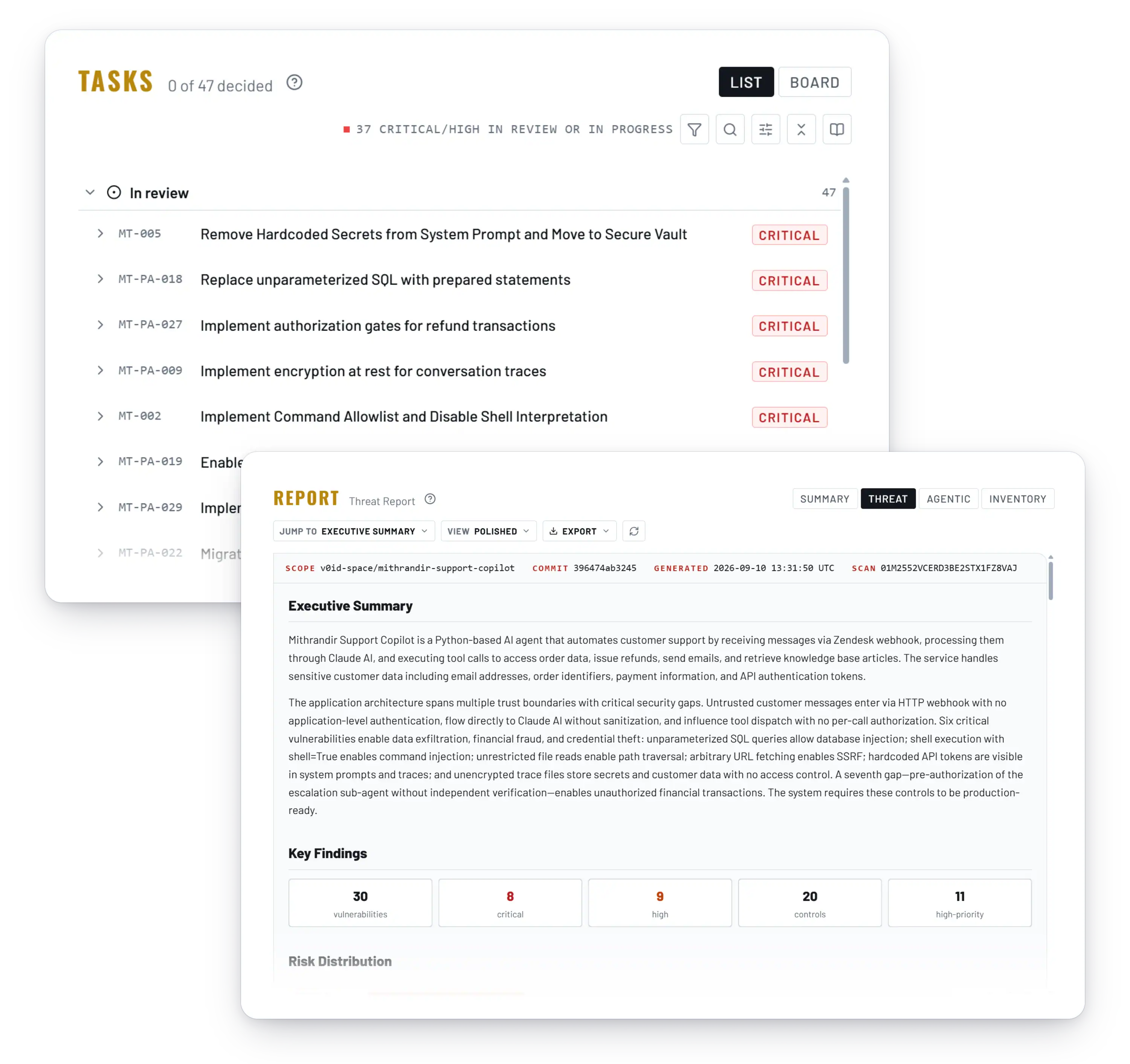
  • Security requirements written with your team, and your decisions on findings carried back into the fix loop
  • Fixed with your coding agents. Every fix verified, with a full audit trail

How Trent Works

Understand. Plan. Secure.

Trent scales the expertise you already have. For agents, that starts with a full inventory.

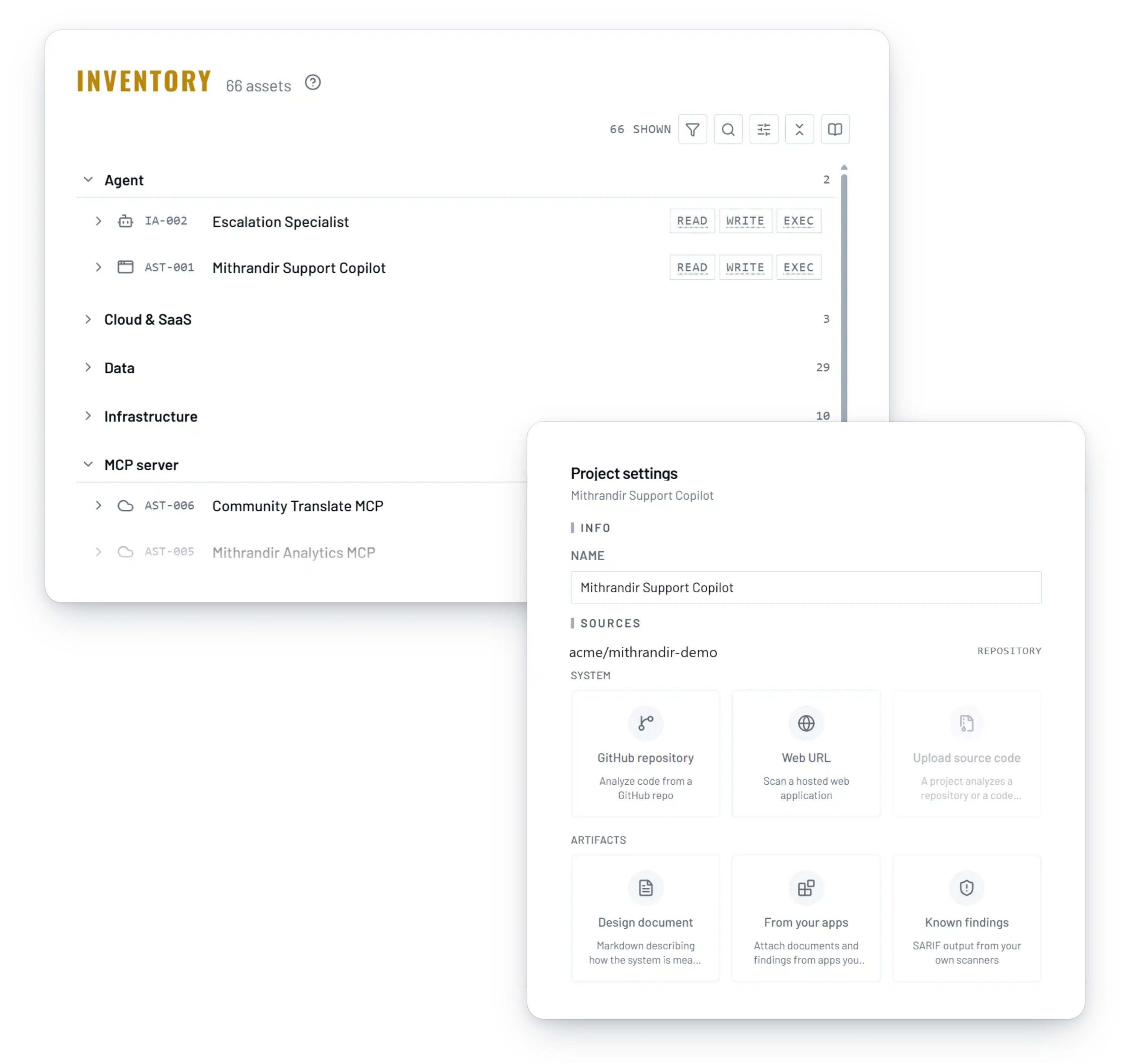
  1. Trent reads your code and configuration and rebuilds the architecture. It lists every agent, tool, skill and MCP server, including ones nobody listed, and maps what each can read, write, execute or send out. It also reads your design docs and the findings from your security tools, read-only. No code yet? Start with the design doc.

    Trent inventory of agents and MCP servers with what each can do, and the sources you can add: GitHub repository, web URL, design document and known findings from security tool

Built for the People Who Answer for Your Agents

Security teams stretched thin

New agents land every sprint, and your team did not grow. Trent builds the inventory and traces the chains for each one, then brings you the findings that need a decision.

Engineering leads shipping agents

Your teams build the agents, and you answer for them. Trent gives you a written answer to what each agent can reach, and fixes that land through the coding agents your developers already use.

Related problems: a threat model that keeps up, the code your agents help write, findings piling up, a stretched security team.

Why Trent

Trent was built for agents from the start. It reads what you build, shows the evidence behind every finding, takes correction, and fixes what it finds with your coding agents. Your code and context never leave your boundary.

Agentic AI Security Platform Leader, 2026 Cybersecurity Stars Awards

Find Out What Your Agents Can Reach

Connect the repository where your agents live, or start with a design doc. You get the list of agents and tools, what each can reach, and the attack chains that matter, ranked. Access and pricing available on request.

FAQs

What is AI agent security?

AI agent security is the work of making sure the agents you build cannot be steered into doing harm. An agent reads data, calls tools and acts on its own, so the risk sits in what it can reach and how those abilities combine. For the basics, read what agentic AI security is.

How do you secure AI agents?

Start with a full list of your agents, tools, skills and MCP servers. Give each agent only the access its job needs. Keep private data, untrusted input and a way to send data out from meeting in one agent, or put an approval step between them. Check your design against a public list such as the OWASP Top 10 for Agentic Applications. Trent builds that list from your code and re-assesses as the code changes.

How does Trent handle MCP servers?

Trent lists every MCP server in your code, maps what each lets an agent read, write, execute or send out, and traces the attack chains that run through it, including prompt injection and tool misuse. Common risks are a server with more access than the agent needs, one token shared across systems, and tool results that carry hidden instructions. Our MCP security post covers them in depth.

Can Trent review an agent before it is built?

Yes. Point Trent at the design doc for the agent. It reads the doc as context and works from there, so a risky design can change before any code exists.

Does Trent stop or block an agent at runtime?

No. Trent is not a runtime guardrail or firewall, and it does not run AI governance. It reviews what you build, the code, the configuration and what each agent can reach, so the risky paths are fixed before they ship. Runtime AI agent guardrails are a different kind of tool.

What happens after Trent finds a problem?

Trent fixes it with your coding agents. It hands them the exact instructions, the agent prepares the pull request, Trent reviews it for security, and after the merge Trent verifies the fix. Findings that need a person come to you with the context and a recommended decision. From fully autonomous to a human in the loop: your call.

How secure are AI agents?

An agent is as secure as what it can reach and what it reads. The most common risks are prompt injection, more access than the job needs, tools used in ways nobody planned, and data leaving through a tool that can send it out. Most can be fixed in the design and the code, before the agent ships.